
Four years ago I stopped folding sweaters into tissue paper and started dropping them into a plastic bag. That was the whole change. Nothing else about the way I pack moved. Same table, same scale, same label printer, same walk to the post office counter. But the time I used to spend building boxes and running tape around clothing orders dropped, and the messages about dented corners stopped coming. The bag I switched to is the METRONIC Poly Mailers, 10 by 13 inches, sold in a 100 pack. I started with that pack in July 2022 and I have been reordering it ever since, which is about four years of steady use.
I sell thrifted women's clothing, shoes, and the occasional piece of vintage kitchenware and housewares. Most weeks that is eight to fifteen packages, and in November and December it climbs. Clothing is the bulk of it, which is exactly the category where a box is usually overkill. A sweater does not need a rigid wall around it. It needs to stay dry, stay closed, and not snag on a sorting belt. I say that up front because this is a review of a bag, and a bag is a narrow tool. It has done one job well for four years and I have never asked it to do another.
The Quick Verdict
Four years, no split seams, no buyer complaints about a wet or an open package. The 10 by 13 size handles folded clothing and nothing fragile, which is exactly the limit I want it to have.
Amazon Check Today's Price →The bag that replaced half my boxes
I go through one 100 pack roughly every two months. At that quantity the per-bag math is the thing that matters, so check today's price before you decide on a quantity.
Amazon Check Today's Price on Amazon →How I've Used It
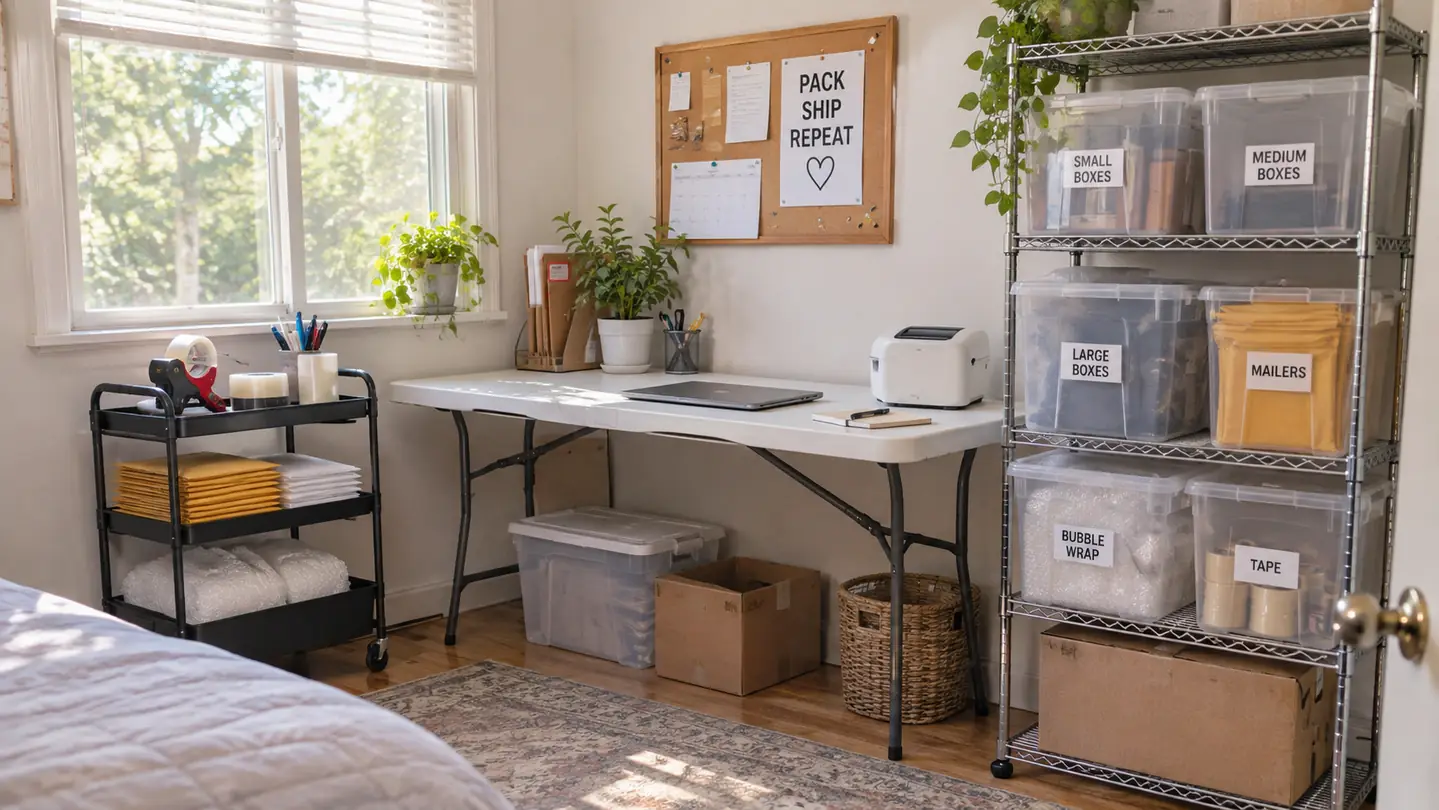
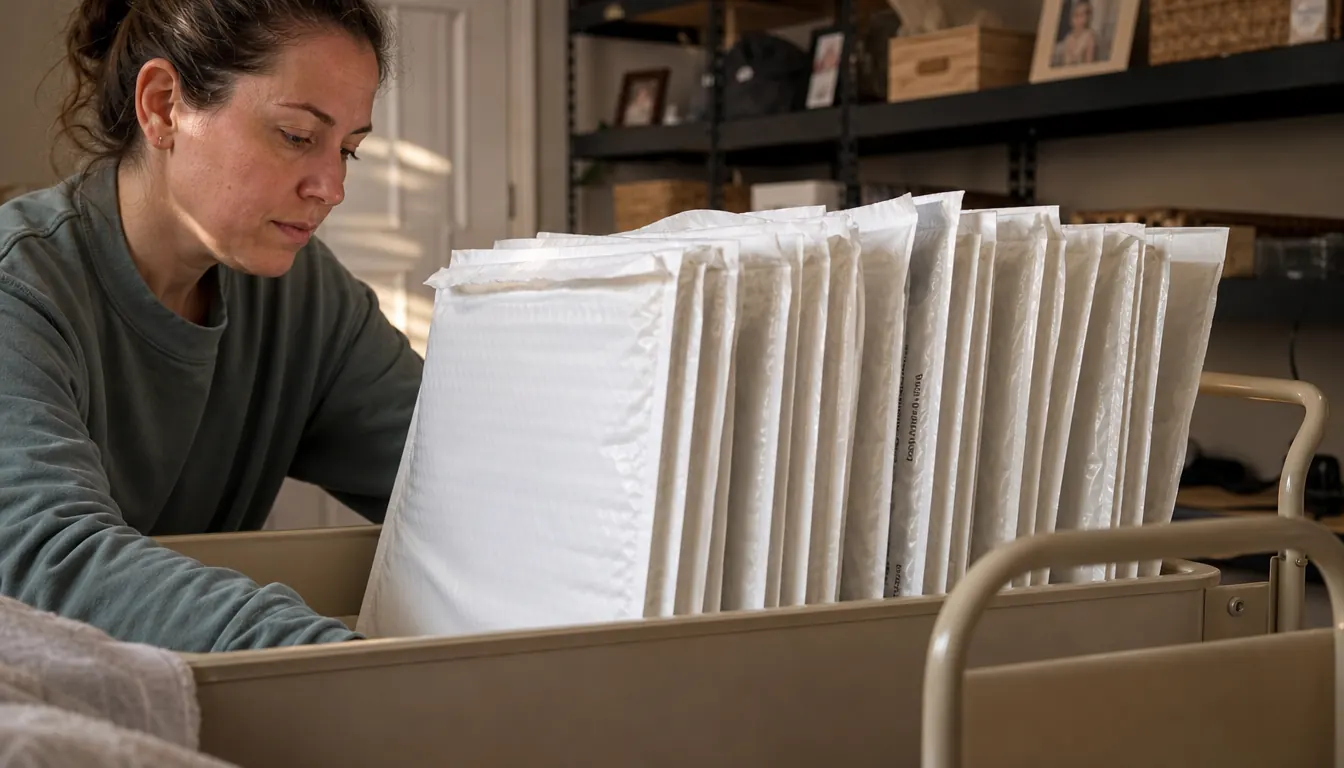
My packing room is a spare bedroom with a six foot folding table, a wire shelving unit of labeled inventory bins, and a rolling cart that holds supplies. The mailers live on the cart in a flat stack. I pull from the top and the brick gets thinner week by week, which is a satisfying thing to watch when you pack the way I do, one order at a time, standing up, with the radio on. There is no dispenser and no rack. The bag comes off the stack and opens with two fingers.
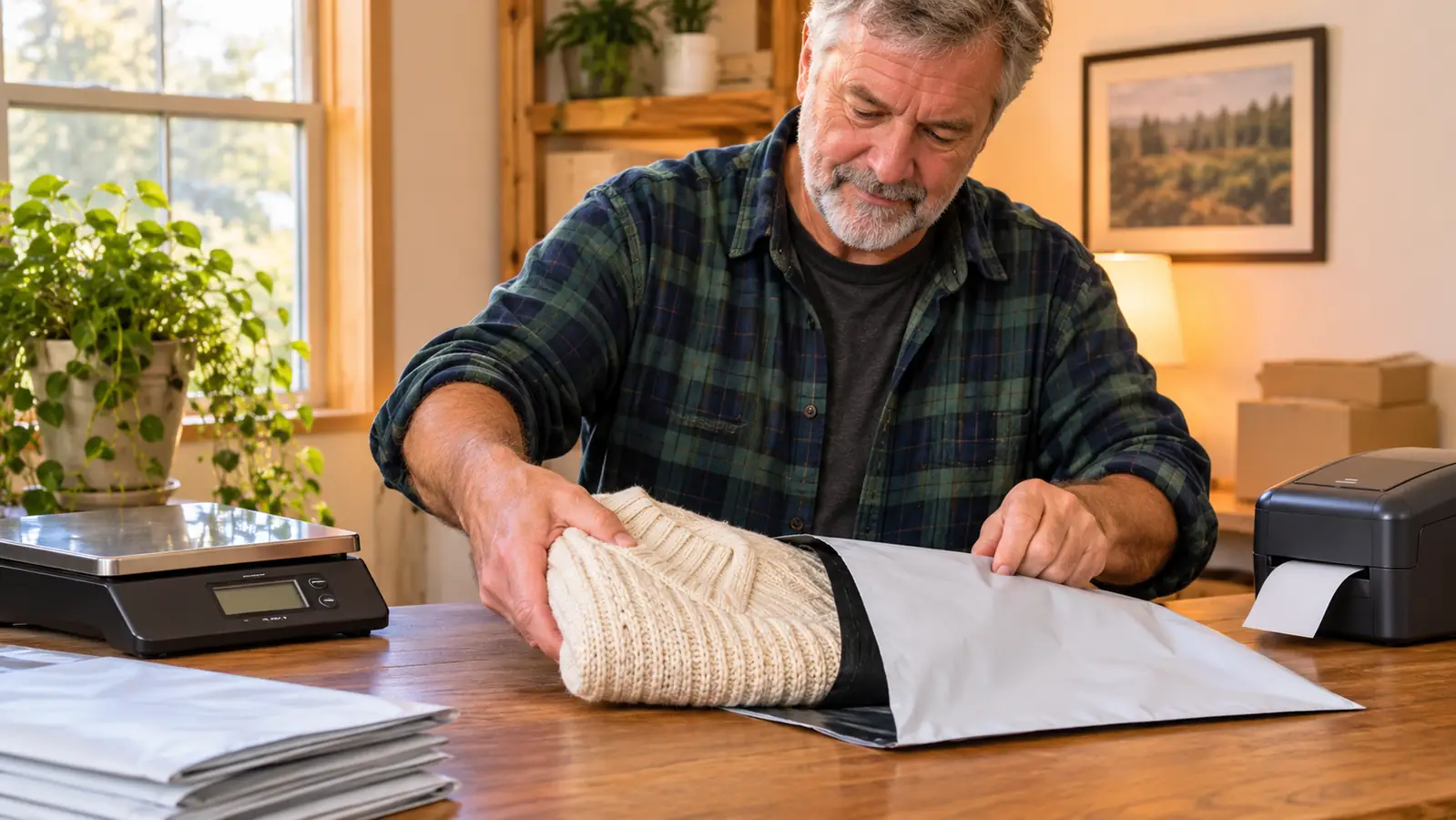
The routine for a sweater is short. Fold it to roughly the footprint of a sheet of paper. Slide it in. Peel the liner off the self-seal strip and press the flap down along its whole length, corner to corner. That is the entire pack. No void fill, no tape over the seam, no box. I set it on the scale beside the printer, print the 4 by 6 label, press it onto the flat face of the bag, and drop the finished package into the bin by the door for the carrier pickup.
What four years has taught me is mostly about the edges of the job and not the middle. The adhesive strip is the part that decides whether the bag is any good, and it has held on every package I have sent. The polyethylene film is thin enough that the bag adds almost nothing to the weight, which matters when a folded sweater plus the bag still lands under a pound on the scale. And 10 by 13 fits a folded adult sweater with a little room to spare. You want that room. A bag stretched tight gets punctured at the corners, and there is no way to tape over it that looks professional.
What a 100 Pack Actually Looks Like in a Spare Bedroom
A hundred mailers arrive as a flat, dense brick. It takes up less shelf space than a ream of paper. At my volume I go through one pack about every two months, so I am storing a season of packaging and not a year of it. That is the right amount. Supplies that sit for a year collect dust and the peel-off liner gets fussy about coming away in one piece.
The bag itself is a single rectangle, open along one long edge with the adhesive strip under a liner. There is no gusset, no expansion panel, no reinforced corner. What you see is what you get, and for clothing that is enough. I have shipped folded jeans in them and jeans make a dense, awkward parcel. The bag takes the shape of the jeans instead of arguing with them, and the bottom seam has never split on me.
Shoes are a slightly different test because a shoe has hard edges. What I ship in a mailer is fabric and soft-soled shoes, canvas sneakers mostly, and I put nothing else into the bag with them. The film takes the shape of the shoe instead of fighting it. Leather boots with a heel go into a box, because a bag cannot protect a heel from a sorting belt and I am not going to pretend otherwise.
The Self-Seal Strip Is the Whole Product
Every poly mailer looks identical in a product photograph. The real difference is a strip of adhesive you cannot see until you peel the liner back. The METRONIC bags use a self-sealing strip, and that seal is the reason I keep buying this particular pack. Once the flap is pressed down along its length, it does not lift. In four years I have never had one arrive open, and I have sent thousands of them.
It is also tamper-resistant in the way a reseller should care about. If somebody peels that flap up to look inside, they cannot press it back down cleanly. The liner is gone and the adhesive takes a little of the film with it. A buyer spots that immediately. For a package holding clothing, that matters more than anything else the bag does.
One honest note. The seal does not forgive a bad fold. If the flap is wrinkled, or if the top edge folds over on itself, you get a gap, and a gap can catch on a conveyor and tear the top open. That is a packing problem and not a product problem. But it is the only failure I have come close to causing in four years, and it is worth saying out loud.
As for the bags themselves, what has failed is small. A liner has torn at the corner once or twice when I pulled it too fast. The adhesive underneath was still fine, so I pressed the flap and sent it anyway. A handful of bags in a pack arrive with the top edge slightly curled from being compressed in the brick, and I flatten those under the inventory bins for a day before using them. No seam has split. No bag has torn in transit. Nothing has come back to me.
Four years of clothing orders and not one has arrived open. The peel-and-press strip is the reason, and it is the only part of a poly mailer that actually matters.
Weight, Tape, and the Conversation at the Counter
I spent twenty seven years behind a post office counter, so I can usually tell what is wrong with a parcel before it reaches the scale. Most of the time it is weight that was never measured at home. The next most common thing is a package that was never properly closed. A bag fixes the second problem outright and helps with the first, because the film barely registers. A folded blouse, a bag and a label is a light package. The scale confirms that instead of arguing with me about it.
The other thing a bag removes is tape. I still own a tape gun and I still use it on every box that leaves this house with glassware inside. But on a run of eight clothing orders the tape gun stays on its hook on the shelving unit. The bag closes itself. That matters because of mild arthritis in my right thumb, and squeezing a bare roll of tape is the motion that hurts. Not repeating that motion eight times in a row is a real improvement to my week, small as it sounds.
Then there is drop-off. I hand packages over at the counter or schedule a free carrier pickup from the porch, and Gene carries the bins out for me. Bags stack flat in those bins. Boxes do not, and a bin of boxes is a two-trip job for him instead of one.
How It Compares to the Boxes I Used to Buy
For the first nine months of reselling I shipped clothing in boxes, because that is what I had in the house. A box for a folded sweater means finding one the right size, which usually means one too big, which means void fill, which means tape on three seams. The whole thing weighed more, and the buyer paid postage on the void fill. If you are doing eight of those in an evening, you are not packing, you are building.
The bag removed all of that. The one thing I gave up is the rigid look. A box feels like a gift. A bag feels like a package. For a secondhand sweater, a package is honest and a box is theater, and I stopped wanting theater once I was the one paying for it in time and in postage. The METRONIC bags are what let me stop building. I still keep a small stack of boxes for glassware and boots. That stack lasts me months now instead of weeks.
Where Poly Mailers Stop Working
I have never put glass or dishes in one of these. Not once in four years. Vintage Pyrex and housewares go into a box with small-bubble wrap, bubbles facing in, and that is a rule I made after breaking a bowl in late 2021. A poly mailer has no crush resistance whatsoever. A sorting belt does not care how carefully you folded something, and a bag will not save a plate.
The second limit is anything with a point or an edge. A framed piece. Flatware with a sharp end. A heel. Sharp corners find the seam on any bag ever made. The third limit is expectation. I once had a buyer ask, politely, why a handbag had arrived in a bag. It arrived in perfect condition. But she expected a box, and expectation is part of the job whether we like it or not.
There is also nothing to hide behind. A bag shows every lump and every crooked fold, and the buyer can see it before the package is even open. That is a feature if you fold well and a nuisance if you are in a hurry. On a bad evening I have re-bagged an order because the first attempt looked like I had packed it with my feet.
What I Liked
- Self-seal strip has held on every package I have sent in about four years
- Adds almost nothing to weight, so a folded sweater still lands under a pound
- 10 by 13 fits a folded adult sweater with room at the corners
- No tape on clothing orders, which spares my right thumb
- A 100 pack stores flat and takes less shelf space than a ream of paper
- Kept a sweater dry through a wet afternoon on the porch
Where It Falls Short
- No crush protection at all, so glass, dishes and framed pieces still need a box
- A wrinkled flap leaves a gap that can catch on a conveyor
- Shows every sloppy fold to the buyer
- Not the parcel a buyer expects for a handbag or anything structured
Who This Is For
If most of what you ship is soft, this is the bag. Clothing resellers mostly, and anyone selling fabric, linens, or anything folded that will not shatter. It suits a home operation with a folding table and a bin by the door far better than it suits a warehouse. And it suits anyone whose hands have opinions about tape, which at sixty one mine certainly do. If you are shipping eight to fifteen packages a week out of a spare room, the 100 pack is sized about right for a season.
Who Should Skip It
If you sell glassware, ceramics, framed art, or anything with a heel, skip this and buy boxes. If your buyers expect a rigid parcel, skip it. If you pack fewer than a package a week, a 100 pack will sit on your shelf long enough for the liner to get fussy, so buy a smaller quantity or split a pack with someone at a rummage sale. And if a sloppy fold is a habit you have no plans to break, a bag will advertise it to every buyer you have.
One bag, one size, ordered about every two months
This is not a complicated supply and it does not need to be. Check the current price on the 100 count, confirm you are ordering 10 by 13, and keep the boxes for the glassware.
Amazon Check Today's Price on Amazon →