
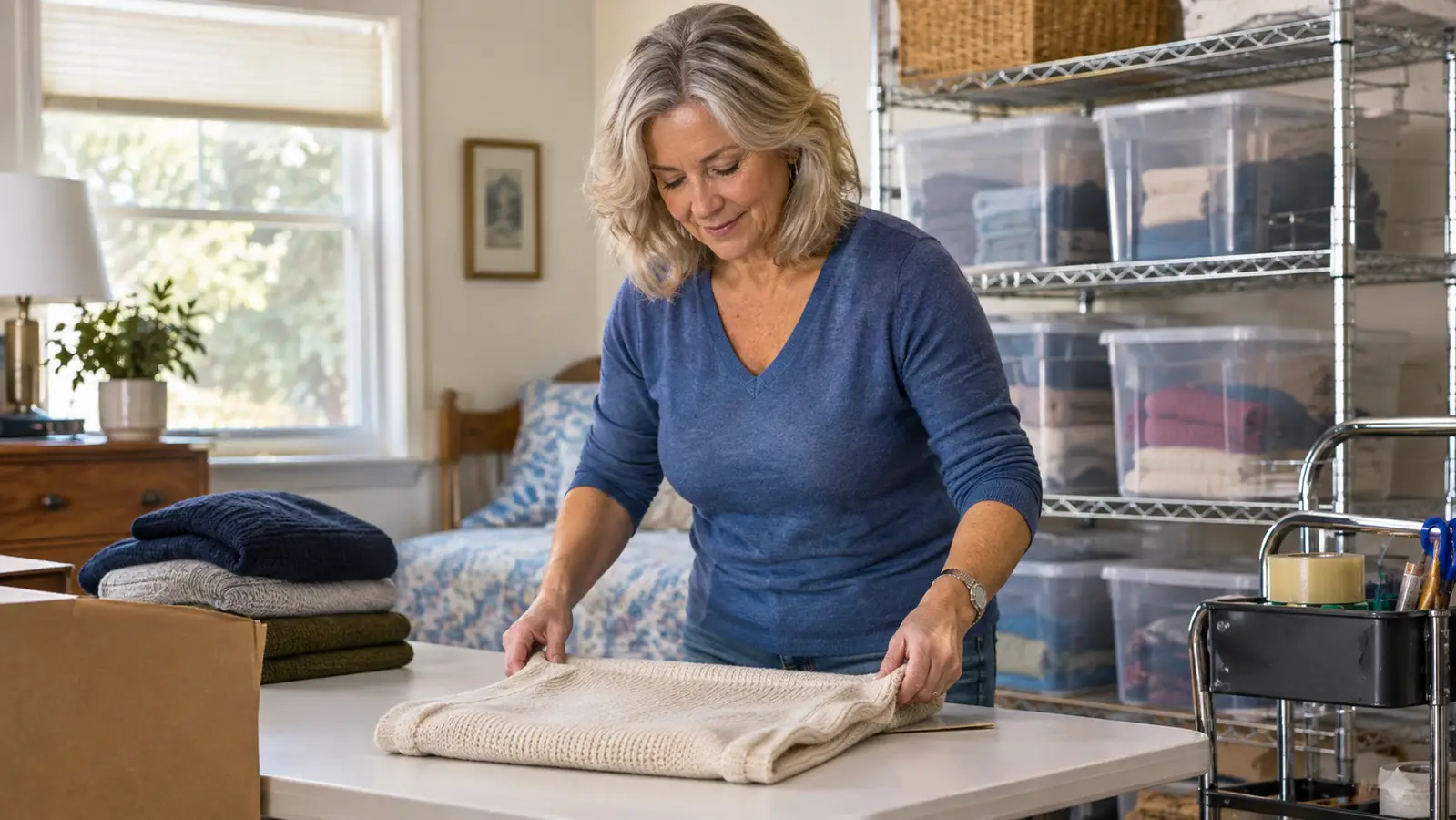
I have answered more questions about poly mailers at a post office counter than any one person should have to. Do they hold. Do they arrive torn. Is it worth buying them a hundred at a time. I spent twenty-seven years behind that counter in a small town post office, and I have spent the last five and a half years on the other side of it, selling thrifted women's clothing, shoes and the occasional piece of vintage kitchenware from a spare bedroom outside Dayton, Ohio. The METRONIC 10x13 poly mailers have been my clothing mailer since July 2022, which is about four years now. This is the honest version of that experience, including the parts that are less flattering.
Honest, in this case, means I am going to spend as much time on what a poly mailer cannot do as on what it can. The listing will not tell you that, and neither will most reviews. I am not going to pretend a ten by thirteen inch plastic envelope is a marvel of engineering. It is a bag with an adhesive strip on the flap. What I can tell you is how it has behaved across four years and several hundred orders, where it has failed, where my own packing failed while the bag did its job, and the one category of order I will not put inside it no matter how far behind I am on a Sunday night.
The Quick Verdict
A quiet workhorse of a mailer that I stopped thinking about years ago, which is the highest compliment I can pay a shipping supply. It is the wrong container for anything with an edge.
Amazon Check Today's Price →The mailer I stopped thinking about
10x13 inches, 100 to a pack, self-seal strip with a tamper resistant closure. Four years of reordering the same bag for clothing orders.
Amazon Check Today's Price on Amazon →What Nobody Tells You About Poly Mailers
The first thing nobody tells you is that a poly mailer is not packaging. It is containment. There is a difference and it matters at the folding table. A box holds a shape, so the thing inside keeps its own. A mailer takes the shape of whatever you put in it, which is exactly why a sweater ships beautifully in one and a teacup does not. It does not cushion, it does not insulate, and it will not stop a corner from bending if the corner is sharp enough. It keeps a soft thing together and it keeps it dry. That is the whole job, and it does that job well.
The second thing is weight, and I did not appreciate this until I had been reselling for a year. I weigh every package on the counter scale next to my printer, and the difference between a garment in a box and the same garment in a mailer shows up on the display. Postage is not the subject of this review, but the reason I keep a shelf of mailers is that they do not add weight I then have to move and account for. If you have ever guessed at a weight and had a package come back, you know exactly why that matters.
The third thing is that the seal is the entire product. Everything else about a mailer is a rectangle of polyethylene film. The self-seal strip on the flap is the only part that can fail in a way that costs you a customer, and it fails in exactly one circumstance: when the flap does not have clean, flat material to press against. I will come back to that, because it is the source of nearly every mailer complaint I have ever heard, including two of my own.
I used bubble mailers for a while before this, and I still keep a few on the shelf for small hard items like a brooch or a single piece of costume jewellery. For clothing I stopped. A bubble mailer is thicker, bulkier to store and heavier to move, and the bubbles do nothing for a folded blouse that already has fabric on all sides. If you are deciding between the two, the short version is this: bubbles for things that can crack, film for things that can only get wet or torn. The exception is anything with a sharp point, which will find the film eventually.
How I've Used the METRONIC 10x13 Mailers
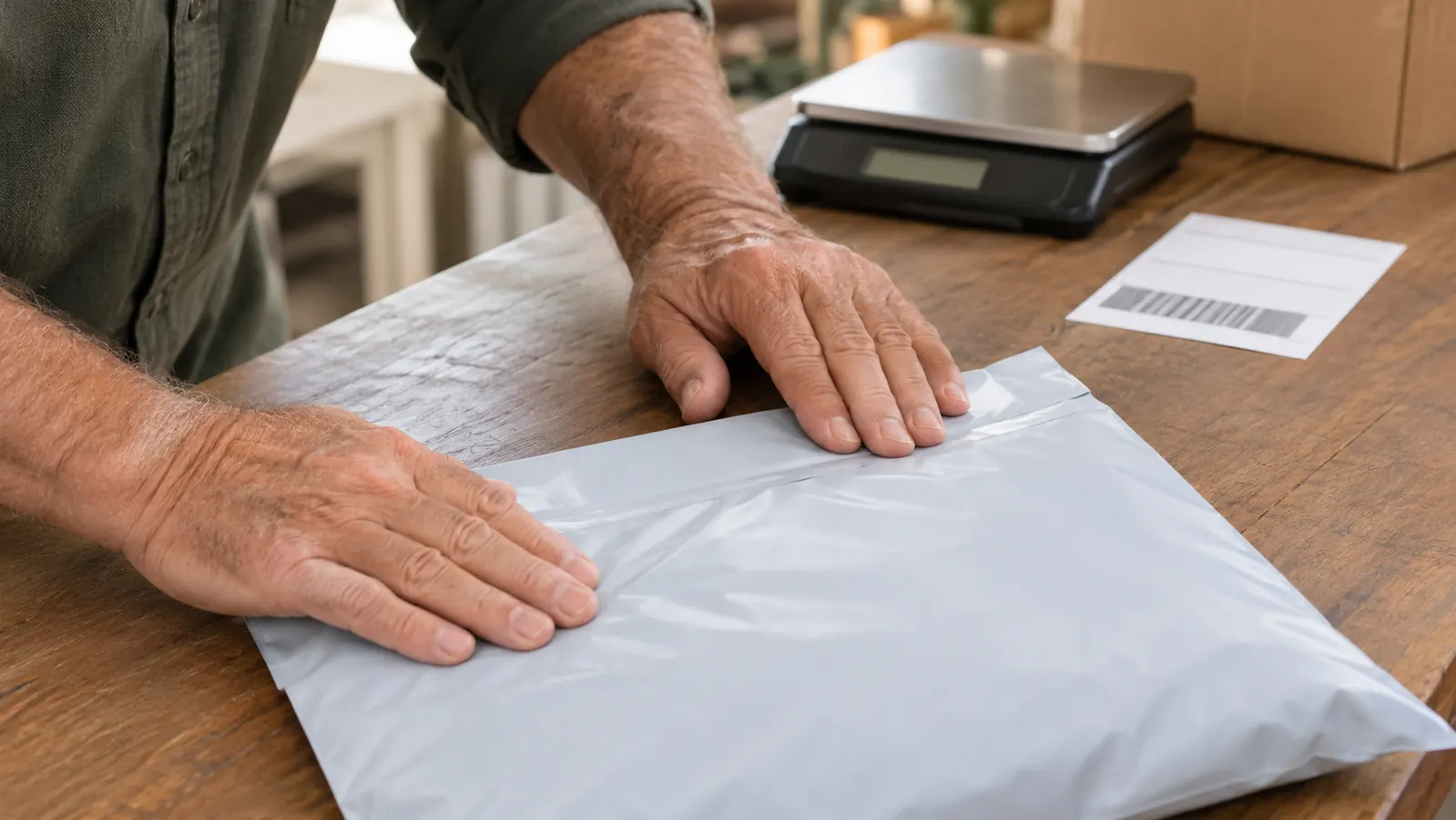
My shipping room is a spare bedroom with a six foot folding table, a wire shelving unit of labeled bins, and a rolling cart I keep loaded so I am not standing up and sitting down all afternoon. The METRONIC mailers live on that cart. A folded pair of jeans, a blouse, a light sweater, a scarf, a pair of flats: all of that goes into a 10x13 without argument. I fold, slide, peel the strip, press the flap, and it is done. No tape, no tissue paper, no fiddling. On a Tuesday with six orders to get out before the carrier comes up the porch steps, that matters more than any bullet point on a listing.
What does not go in: anything glass, anything with a rim or a lid, anything I would be upset to find in pieces. I sell vintage kitchenware and housewares, and those orders go into boxes with Duck small-bubble wrap around them, bubbles facing in. I have not put a piece of Pyrex in a poly mailer in four years and I am not going to start. This is not a knock on METRONIC. It is a statement about what an envelope is for. A mailer that fails is almost always a mailer that was asked to do a box's job.
The sizing is more forgiving than the number suggests and less forgiving than beginners hope. Ten by thirteen inches is a real limit once you fold. A chunky cable knit sweater needs to be compressed and rolled, and even then it makes a mailer that looks like a stuffed pillow. That is fine for a coat, less fine for something a buyer expects to open flat and hang. I have learned to fold to the bag rather than to my own preferences, which sounds obvious and took me about a year to actually do.
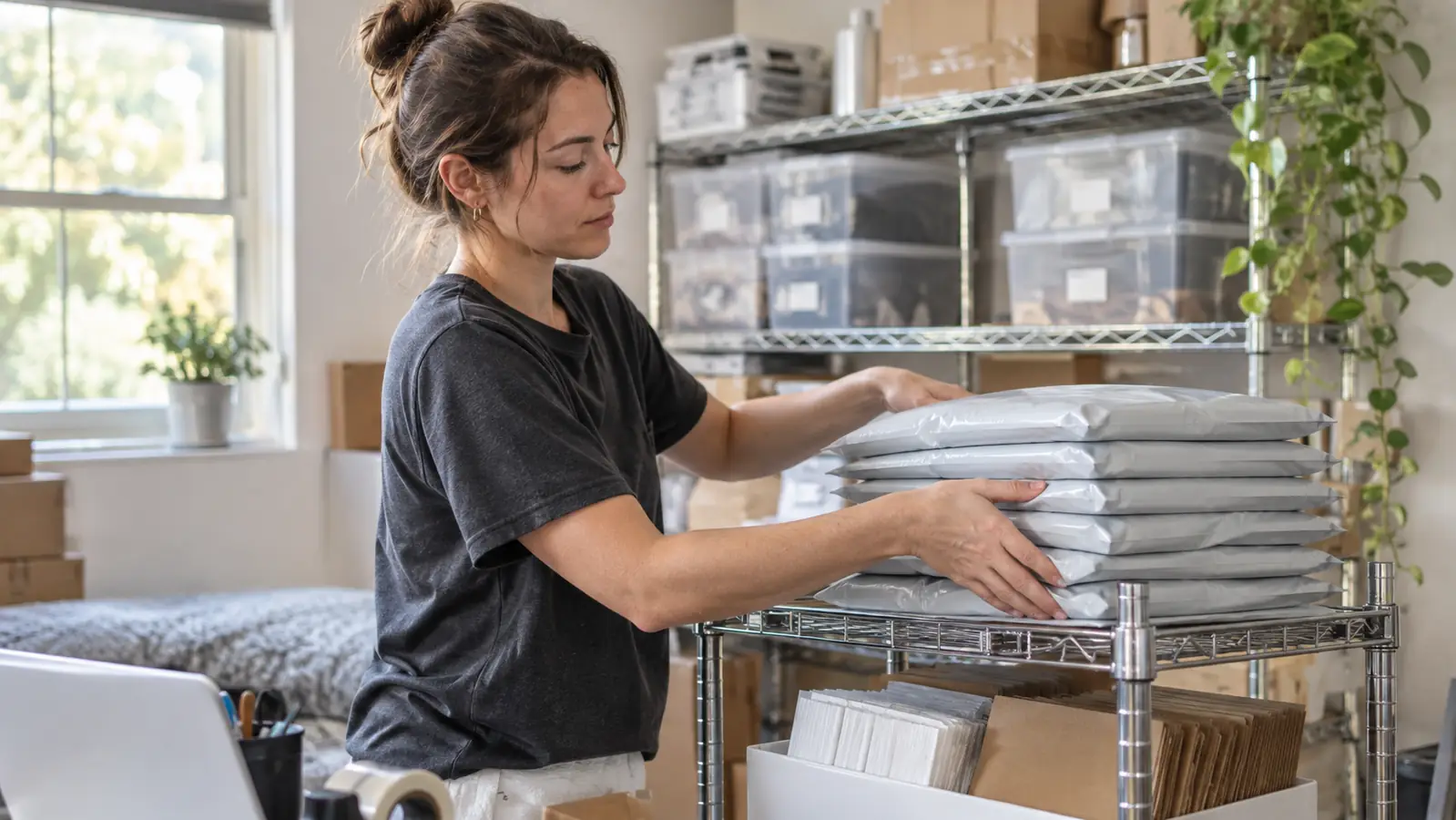
Most weeks I schedule a free carrier pickup rather than drive anywhere. The filled mailers stack in a bin by the door, and because they take the shape of the garment, a stack of eight sits lower than a stack of eight boxes would. When the carrier comes up the porch steps, she can carry the whole bin in one trip. If you have ever watched someone wrestle a tower of boxes in the rain, you understand why I care about that more than I care about almost any other detail of a mailer.
A poly mailer does not protect anything. It contains what you already protected.
The Seal Is the Whole Product
The closure is a self-sealing adhesive strip on the flap, and the listing calls the result tamper resistant, which I have found accurate in the way that matters. Once that flap is pressed down, opening the bag means tearing it. A buyer cannot open a mailer, decide against a blouse, and reseal it so it looks untouched. For clothing that is a small, quiet advantage, and it is the reason I stopped bothering with other bags I tried years ago. It also means a bag that arrives torn is obviously torn, which saves an argument.
The failure mode is overstuffing, and I have caused it myself more than once. If the contents push up into the fold, the flap cannot lie flat, and a flap that does not lie flat does not seal. You get a bag that looks closed on the table and opens in the truck. The fix is not more adhesive and it is not tape. The fix is taking something out. I keep a larger bag on the cart for the days when a sweater turns out to be two sweaters, and I have never once regretted the extra inch.
One thing I watch in the shipping room is temperature. The room gets cold in January, and cold makes an adhesive strip less eager. I keep the working pack on the cart inside the house rather than in the unheated garage, and I press the flap and hold it for a second rather than trusting it to grab on its own. I cannot tell you the chemistry of it. I can tell you that the two bags that came open in four years were both sealed in a cold room in a hurry, and both were my fault, not the bag's.
What Four Years of Reordering Taught Me
I reorder the 100 pack roughly every two months, which works out to about six packs a year. That cadence has held steady through slow summers and through Novembers where the cart empties in a week. The bags store flat, so a full pack goes into a bin on the wire shelf and takes up less room than a stack of boxes would. Nobody markets that as a feature, but in a spare bedroom where every square foot is spoken for, flat storage is worth mentioning.
Four years and a lot of packs in, I have not had a bad batch. The film has been consistent, the adhesive has been consistent, and the flaps have peeled cleanly every time. I still check the first bag of any new pack, out of old counter habits: strip still covered, bags not fused together at the edges, nothing stuck to itself in storage. I have not had to send a pack back. If I had, I would tell you, because a review that contains only praise is a brochure.
What I would change if I could: nothing about the bag itself, honestly. I would change the fact that the pack does not come with any kind of dispenser, so I pull one off the top of the stack and the rest slide around. I solved that with a small bin and a rubber band. That is the entire list of complaints I have accumulated in four years, and it is a mild one. When a product's weaknesses are all things you can fix with a bin and a rubber band, you have found something durable.
Things I stopped doing: taping over the flap, which was pure nerves and bought me nothing but a slower afternoon. Stuffing tissue paper in for padding, which does not pad anything and just makes the bag rounder. Writing the order number in three places instead of one. The bag does not need help. The habit I kept is weighing before sealing, because once that strip is down, adding a packing slip means starting over with a new bag.
Weight, Weather, and the Small Habits
The bags are described as waterproof and I would not argue with that in the sense that matters. A mailer left on a porch through an Ohio rainstorm has arrived with dry clothes inside. That is a low bar, but it is the bar I care about. What I would not expect a polyethylene bag to do is protect against crushing or cold, and it does not pretend to. Tear resistance is real but relative: a bag will survive a sorting machine and will not survive a box cutter, so pack it as though it is going to meet one.
The one thing I would tell a new seller is to weigh first. My scale reads to a tenth of an ounce and I keep it plugged in next to the printer, and taking that reading before the flap goes down has saved me more aggravation than any other habit in that room. It also tells you quickly whether what you just built is going to fit the rate you quoted. The mailer is part of that calculation, and it is a small part, which is rather the point of it.
If you are coming from boxes, the thing to get used to is that the bag will not look tidy at the destination. A sweater in a mailer arrives as a soft brick with a slightly rumpled profile, and buyers are used to it. I have never had a clothing buyer complain about the bag. I have had one complain that a dress was folded in thirds instead of halves, which tells you where the real standards live.
What I Liked
- Self-seal strip holds on the first press, no tape required
- Takes the shape of clothing, so a folded sweater ships without a box
- Waterproof film has kept garments dry on wet porches
- Tamper resistant closure means a torn or opened bag is obvious
- Stores flat in a bin, which matters in a small shipping room
- 100 to a pack, reordered about every two months for four years without a bad batch
Where It Falls Short
- The flap will not seal over a bulge, and overstuffing is easy to do
- No padding at all, so nothing with an edge belongs inside
- 10x13 is a hard ceiling once you fold a bulky knit
- The film offers no protection against crushing
- Wrong container for glass, dishes or anything vintage and fragile
Who This Is For
This is for the person shipping soft goods in volume: clothing, shoes, linens, scarves, anything you can fold and press flat. If you sell on eBay or Poshmark out of a spare room and your orders are mostly garments, a shelf of these will do more for your afternoons than almost anything else you can buy. It is also a good fit for anyone with hand trouble, because the seal needs a press from the flat of the hand rather than a hard pinch. I have arthritis in my right thumb and I have never once needed the tape gun to finish a mailer.
The other person this suits is the one who is tired of taping. A mailer takes about eight seconds from fold to sealed, and none of those seconds involve a tape gun. In a December week where the cart empties faster than I can fill it, that difference is the reason I get to sit down at a reasonable hour. I still use the tape gun, but only on boxes, and only because squeezing a bare roll of tape hurts my thumb.
Who Should Skip It
Skip it if you ship glass, ceramics, dishes, framed art, or anything with a lid or a handle. Those orders need a box and real cushioning, and no amount of care at the flap will change that. Skip it if your buyers expect a box, which happens with some higher end clothing and with anything sold as a gift. And skip the 10x13 entirely if your inventory runs to bulky coats and bedding: buy a larger size rather than fighting this one, which is a lesson I learned the slow way with a puffer jacket in February.
That is the whole review. A bag that has never once been the reason an order went wrong, at a size that suits folded clothing, on a reorder cycle I do not have to think about. Four years in, it is still the first thing I reach for on the cart and the last thing I worry about when I hand a bin to the carrier.
Four years, one bag, no complaints worth writing down
If your orders are clothing and your table is small, this is the mailer that gets out of your way. 10x13 inches, self-seal, 100 to a pack.
Amazon Check Today's Price on Amazon →