

In the fall of 2021 I shipped a piece of vintage Pyrex and heard back from the buyer four days later with a photograph of two halves. I had wrapped it. I had used a lot of wrap. What I had used was the wrong kind, and the bowl arrived cracked clean through at the rim. Everything I have done since then starts from that photograph.
Since January of 2022 I have used Duck small-bubble cushioning wrap, the 12 inch by 175 foot roll, for every dish, glass and piece of vintage kitchenware that leaves my shipping room outside Dayton. That is nearly five years of boxes going out at eight to fifteen a week, more in November. I have not had a dish arrive broken since I switched. What follows is the plain list of reasons why, in the order they occur to me while I am standing at the folding table.
The roll that ended my run of broken dishes
12 inches wide, 175 feet on the roll, perforated every 12 inches so it tears by hand. This is the exact Duck wrap I have bought since January 2022.
Amazon Check Today's Price on Amazon →Small bubbles bend around a bowl's curve instead of bridging it
Large-bubble wrap does one thing well: it holds a flat surface flat. A mixing bowl is not flat. Lay a bowl on big bubbles and the wrap touches it at four or five high points with open air between them, and open air is not cushioning. The small bubbles on this Duck roll bend with the curve. The whole side of the bowl ends up in contact with something that gives. That is the difference between a bowl that survives a hard landing on a sorting belt and one that does not.
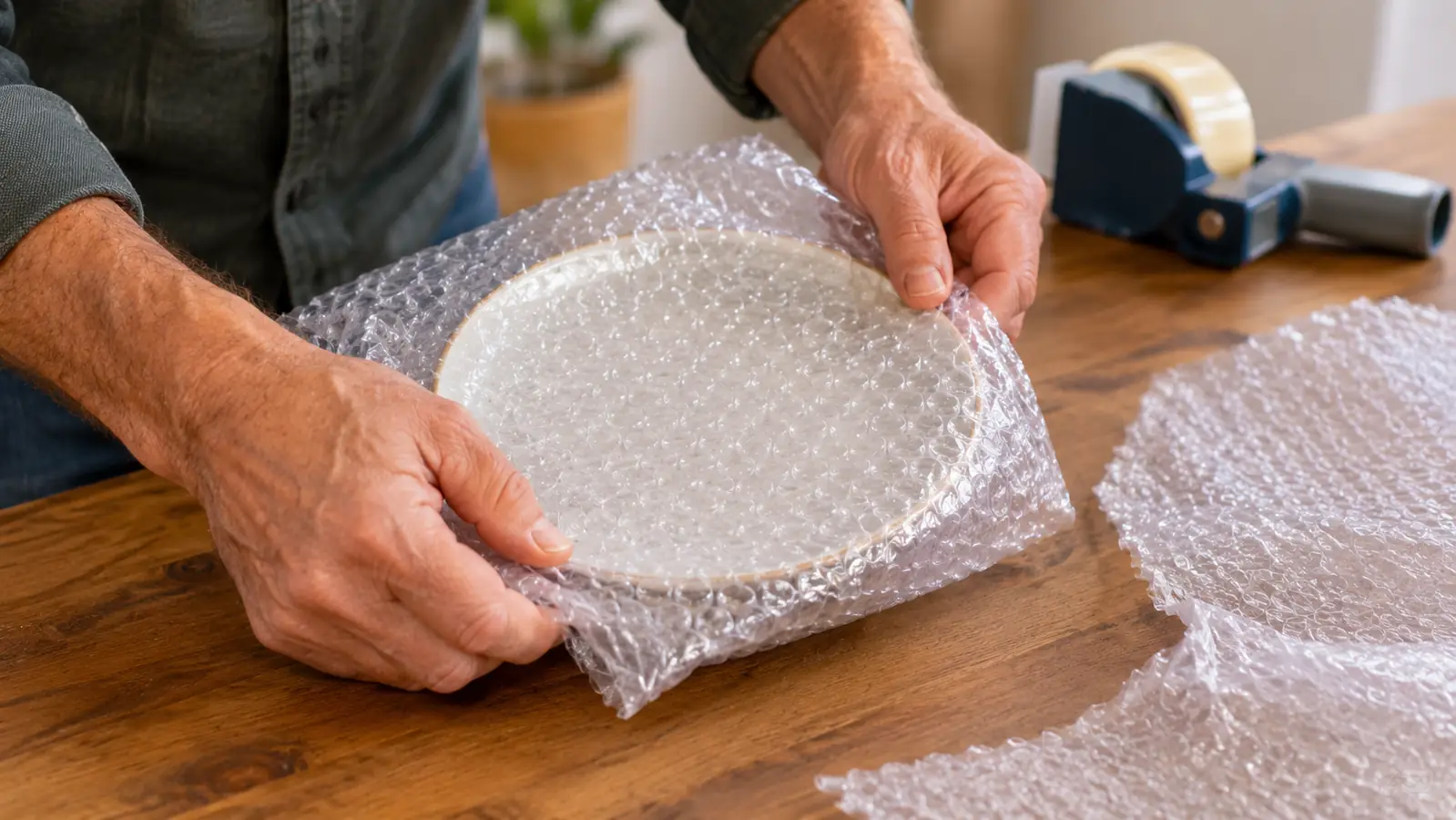
It tears at the perforation every 12 inches, so the scissors stay in the drawer
The roll is perforated every 12 inches. That sounds like a small thing until your right thumb has arthritis in it and you have spent an hour cutting sheets at a folding table. I tear a sheet off with both hands, one thumb on each side of the line, and it comes away clean. No scissors, no ragged edge, no tape measure. Twelve inches is right for a dinner plate and right for a serving bowl, and when I need a longer piece I tear two.
Bubbles facing in puts the flat side against the box wall
The instructions on the roll say to wrap bubble side in, and that is how I do it. The bubbles press against the dish and hold it away from everything else. The smooth flat side faces out toward the corrugated wall. When one box slides against another in the truck, the scuffing lands on the flat plastic instead of popping the bubbles the dish is resting against. One layer, working in both directions.
It adds almost nothing to what the scale says
A full roll weighs 1.1 pounds. A sheet off that roll weighs a fraction of an ounce, and three wrapped bowls together do not move the Accuteck more than a couple of tenths. I have not had a package come back for postage due since I started weighing every box, and I would rather not spend that margin on packing material that weighs as much as the item inside. The scale reads the dish. That is what I want it to read.
It wraps the rim and the face of a plate in one pass
A dinner plate breaks at the rim far more often than in the middle. I lay the plate on a torn sheet, bring the wrap up over the face, and roll the edge so the rim gets two thicknesses before I fold the back over. One pass with the Duck wrap, no folding gymnastics. A stack of four plates done that way takes me about two minutes and the box does not end up any bigger than it was going to be.
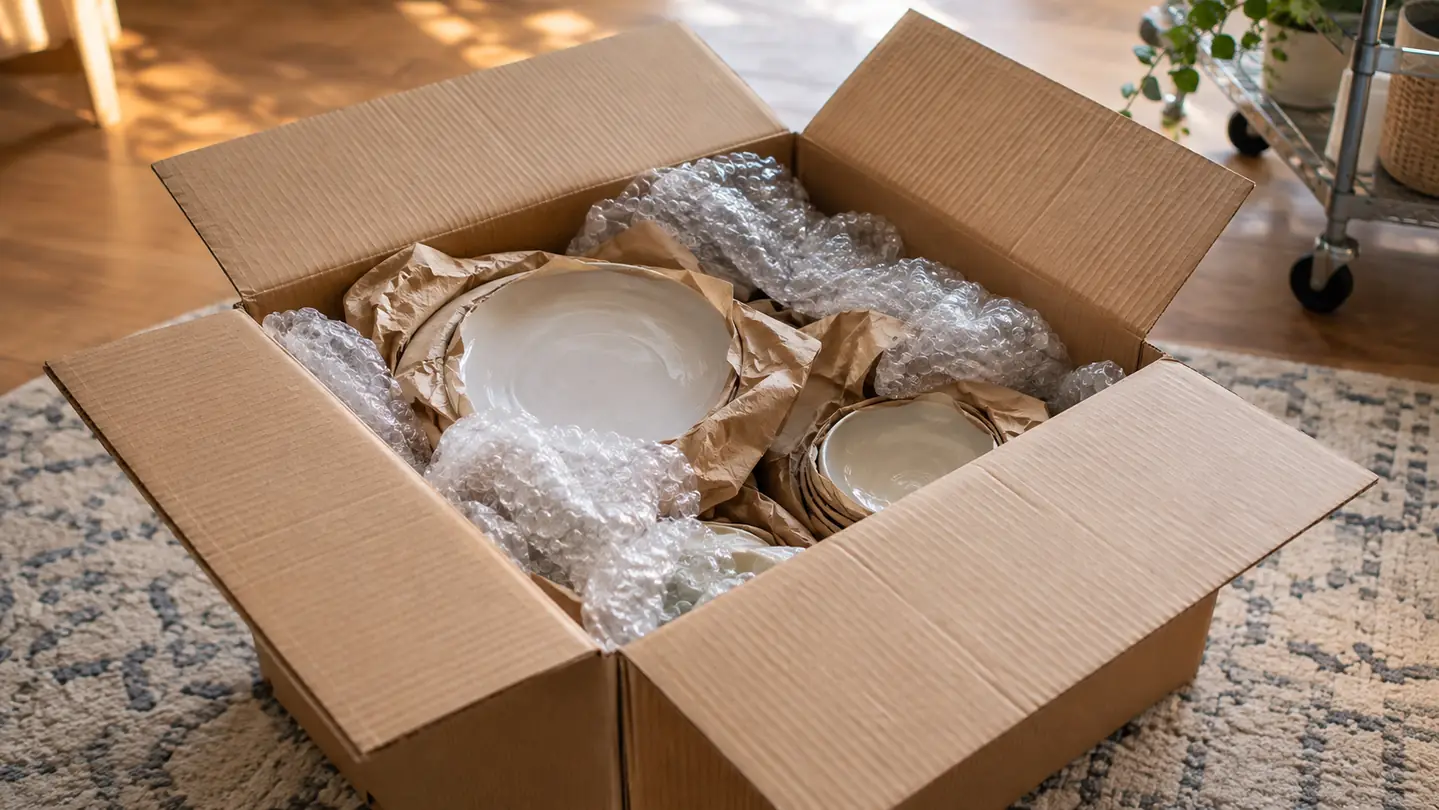
It turns the corner on a handle or a spout
Handles and spouts are where a piece is most likely to snap, and they are also where standard wrap refuses to cooperate. A cream pitcher's handle sticks out into space and big bubbles will not hold onto it. Small bubbles will. I wrap the body first, then run a narrow strip around the handle where it joins the shoulder, pressing the wrap into the inside curve. Same treatment for a teapot spout and the knob on a casserole lid.
It fills the void so the wrapped piece cannot slide
A box two inches wider than the item on every side is the right box, and those two inches still have to be filled with something. Loose void is how a well-wrapped dish still arrives cracked. I tear a long strip, crumple it just enough to give it some spring, and pack it around the sides and across the top until the wrapped piece will not shift when I push on it with one finger. Then the lid closes flat.
It separates a set of four without making the box bigger
Four soup bowls go in one box, each wrapped on its own, then stacked. If I tried that with a heavier cushioning I would be into the next box size and paying postage on air. The Duck wrap adds maybe a quarter inch to each bowl. The stack stays compact, the box stays the size I planned on, and every bowl still has its own layer between it and the next one down.
I can see the rim through it before the tape goes on
Clear wrap is a working advantage, not a cosmetic one. Before the tape goes on I do a last look at every piece, and I can see the rim of a plate or the lip of a bowl right through the wrap without unwrapping anything. Twice this year I have caught a hairline crack that way before the box was sealed. With opaque packing material that bowl goes out the door and comes back.
It folds into corner pads and the fold stays put
The four bottom corners of a shipping box are where the impacts land, and a folded sheet of this small-bubble Duck wrap keeps its fold. I tear four short pieces, fold each one over itself twice, and press one into each corner before anything else goes in. They stay where I put them instead of springing open. That one habit is the reason I stopped finding shattered rims on pieces that had been packed correctly everywhere else.
Nearly five years, eight to fifteen boxes a week, and I have not had a dish arrive broken since January 2022.
What I'd Skip
Poly mailers, for anything that can break. I use my Metronic 10x13 mailers for sweaters, blouses and jeans and they are fine for that, but a glass or a dish in a mailer is a break waiting for a sorting belt. Foam peanuts, because they migrate to the top of the box and leave the dish sitting on bare cardboard by the time it arrives. Kraft paper on its own, because it pads a flat surface and does nothing at all for a curve. And wrapping so generously that the lid bulges: if the box will not close flat, it loses the strength the corrugated gives it and the whole exercise is wasted.
Start with the 12-inch roll and a box of dishes you are fond of
Duck small bubble cushioning wrap, 12 inches by 175 feet, perforated every 12 inches. Wrap bubble side in, fill the void, and tape it shut flat.
Amazon Check Today's Price on Amazon →