
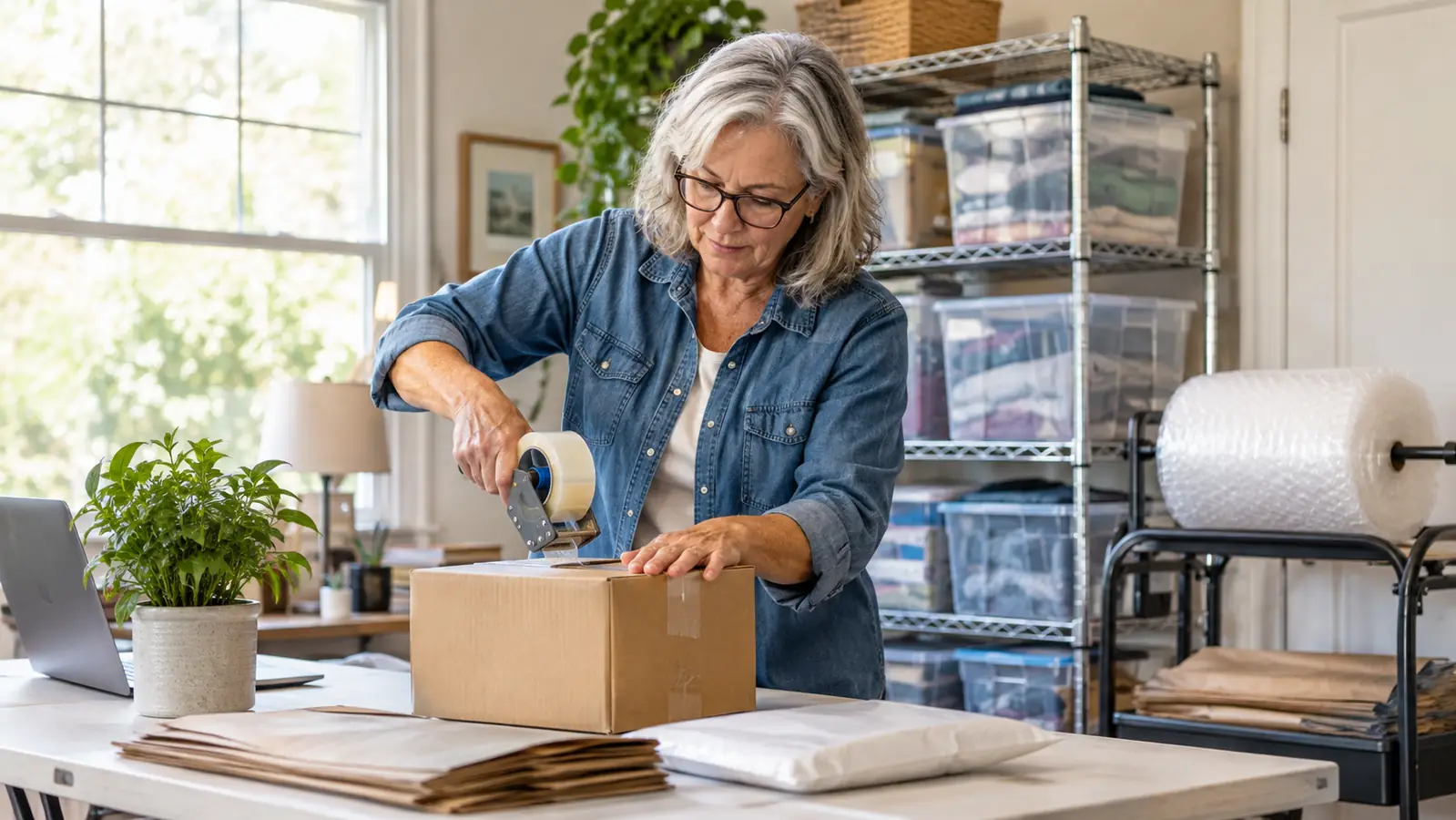
Short answer: for anything that can crack, Duck small bubble cushioning wrap is the material that actually protects it, and for the empty air left in the box, packing paper is the cheaper way to fill it. That is the whole decision, and it took a broken bowl for me to learn it.
I sell thrifted glassware, vintage Pyrex, and the occasional set of ironstone plates out of a spare bedroom outside Dayton, Ohio. I started reselling in the spring of 2021, about five and a half years ago, and I have bought Duck wrap since January 2022. That is nearly five years of tearing sheets off a 12 inch roll. A stack of kraft packing paper sits on the shelf next to it. Both earn their place. The trouble starts when a seller asks one of them to do the other's job.
Here is the difference in plain terms. Bubble wrap is a cushion. It puts a layer of trapped air between the china and the cardboard, and air is what absorbs a drop or a bump on a conveyor. Packing paper is a pad and a filler. It stops items from sliding into each other and it takes up space so nothing rattles around. Paper wrapped tight around a bowl feels protected, and it is not. The shock still travels through it.
| Duck Small Bubble Wrap | Packing Paper | |
|---|---|---|
| Glass and ceramic | Small bubbles wrap a bowl and hold it off the box wall; no glass has arrived broken since I switched | Pads the surface but does not absorb a drop; the shock goes straight through |
| Filling empty space | Works, but you spend a lot of it taking up air | Crumpled sheets fill a big gap for very little money |
| Odd shapes and corners | Small bubbles conform well, but a thin handle can pop them | A sheet folds around a handle or a frame and stays folded |
| Getting a sheet off the supply | Perforated every 12 inches, so it tears straight by hand | Tears by hand, but there is no line, so edges come out ragged |
| Weight added to a parcel | The whole 12 inch by 175 foot roll weighs 1.1 pounds | Heavier per cubic foot once crumpled |
| Clean hands, clean china | No ink and no paper dust on a white plate | Newsprint smudges and kraft sheds fibers |
| Cost per box | More per box, and worth it on anything breakable | The cheaper way to pack a box of soft goods |
| Reusing what arrives | Bubbles flatten after one hard trip | Paper can be smoothed out and used again |
| Storing the supply | A roll stands in the corner of the shelf unit and takes little floor space | A flat stack slides under the table |
Where Duck Bubble Wrap Wins
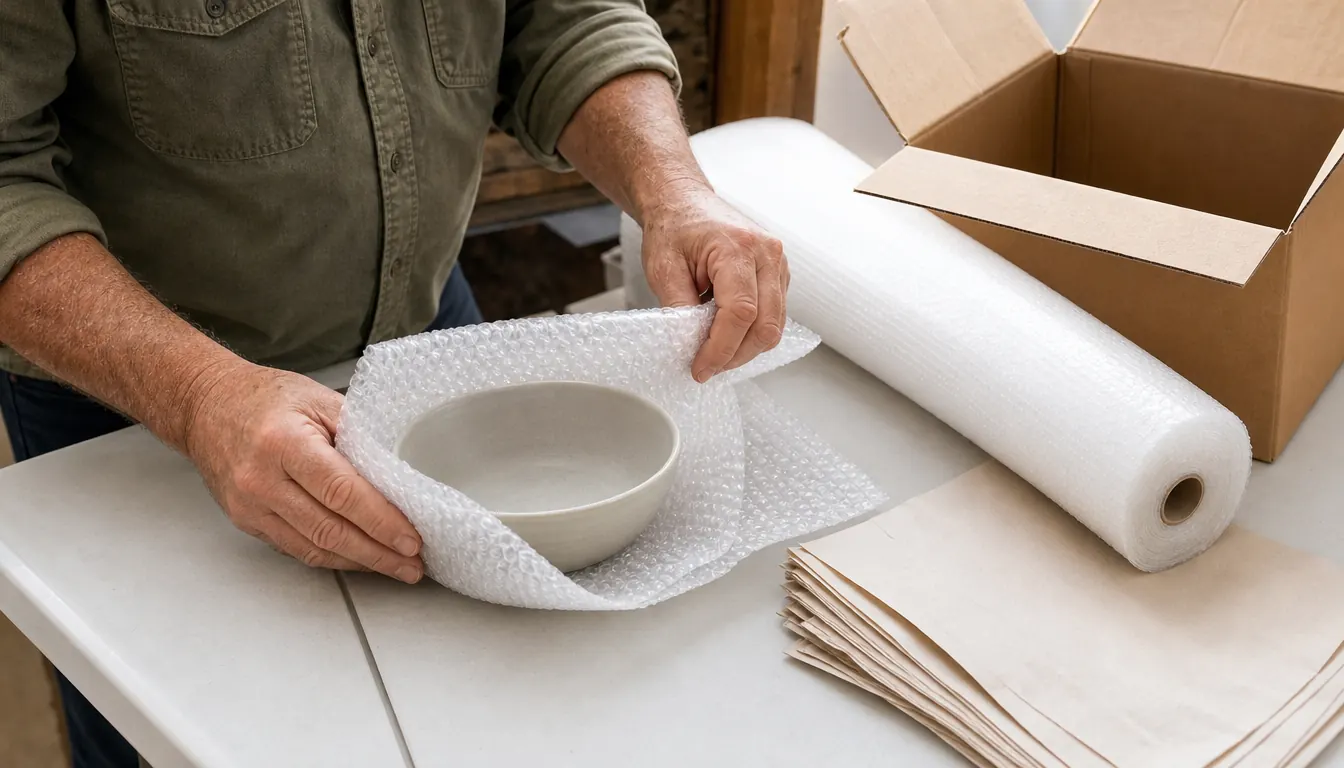
Start with the item that made me switch. In late 2021 I shipped a Pyrex bowl that arrived in three pieces, packed in paper, and I still think about it. Since January 2022 I have wrapped every piece of glass in the Duck small bubble wrap and nothing glass has arrived broken. The small bubbles are the reason. They conform to a rim or a handle instead of tenting over it and leaving a gap, which is what the wider bubble does on anything smaller than a dinner plate. The listing's own instruction is to wrap bubble side in, and that is right. Bubbles facing the china, smooth film facing out.
The second thing is weight. The whole 12 inch by 175 foot roll weighs 1.1 pounds, and small bubbles are light as air, so a box of four bowls does not turn into a box of four bowls plus a sack of gravel. I weigh every parcel on the scale next to the printer and I would notice. Nothing complicates a shipment faster than packing material that pushes a parcel over a weight break. Paper is not heavy either, but it takes a great deal of crumpled paper to fill the same volume, and the ounces add up across a box.
Third, and this matters more than people admit, the wrap is clean. It has no ink and it does not shed paper dust onto a white ironstone plate. Newsprint smudges on the glaze and kraft paper leaves fibers in the bottom of a bowl. If I have to wipe a piece down again after unwrapping it, the customer is going to do the same and think less of the item. The perforation matters too. Every 12 inches there is a line, so I tear a sheet by hand with my right thumb. No scissors, no cutting mat, no squeezing. With arthritis in that thumb, small conveniences are not small.
The roll itself is easier to work with than I expected. I keep it standing upright on the lower shelf of the wire unit, so I can pull a length toward me without lifting it or hunting for the loose end. A sheet is 12 inches wide, which is the right width for a dinner plate and slightly generous for a teacup, and I have stopped measuring because the perforations do it for me. For a bowl I pull two sections, 24 inches, and tear. That gives a double layer around the body with enough left over to fold across the rim, which is where a chip always starts. For a set of four tumblers I count sheets before I begin: four wraps, plus two more for the spaces between them in the box. Counting first means I am not halfway through a stack of glass and out of material with a box sitting open on the table and the tape already on the cart.
Where Packing Paper Wins
I am not going to pretend paper has no job. It is the best void filler I have found for the money. A box of six tumblers gets a bed of crumpled paper in the bottom, the wrapped glasses on top, and a loose layer over them so nothing shifts. Two or three sheets do the work of another whole length of bubble wrap in the empty corners. When I run short of something to fill a gap with, the paper is what is left, and the box still goes out tight.
Paper also wins on flat and awkward shapes. A framed print, a plate with a big handle, a teapot with a spout: a sheet folds around those and stays folded. Bubble wrap will conform to a lot, but a thin, hard corner can pop a bubble, and then that spot has no cushion at all. For anything that simply cannot break, the paper is the cheaper and faster wrap per box. Sweaters, jeans, books, and shoes never see the bubble wrap in my shipping room.
The place paper really earns its keep is the top of the box. After the wrapped pieces go in, there is almost always a gap between the highest item and the flaps. If I leave that gap, the box gets compressed somewhere in the system and the contents get a running start at each other. So I take two or three sheets, crumple each one loosely into a ball, and lay them across the top so the flaps press down on paper rather than on china. That takes about thirty seconds. Filling the same gap with bubble wrap would use a length I could have spent on another bowl, and it would not compress the way crumpled paper does. Paper gives a little and then holds. Bubble wrap gives a little and springs back, which is exactly what you want around the item and not what you want sitting on top of it.
I also keep a sheaf of paper on the rolling cart for the items that do not need a cushion at all. A stack of paperback books, a pair of leather boots, a cast iron skillet, a bundle of linen napkins. Wrapping a skillet in bubble wrap would be a waste of a good sheet, and the skillet would not thank me. That is the division of labor in one sentence: paper for the things that can scuff, wrap for the things that can shatter.
The one roll I buy again and again for anything glass
Small bubbles that conform to a rim instead of tenting over it. 12 inches wide, 175 feet per roll, perforated every 12 inches so a sheet tears off by hand. This Duck roll is what every piece of glass in my shipping room has been wrapped in since January 2022.
Amazon Check Today's Price on Amazon →The last thing I broke was a Pyrex bowl in late 2021. Since I started buying Duck wrap the following January, no glass has arrived broken.
How I Pack a Box That Has Both
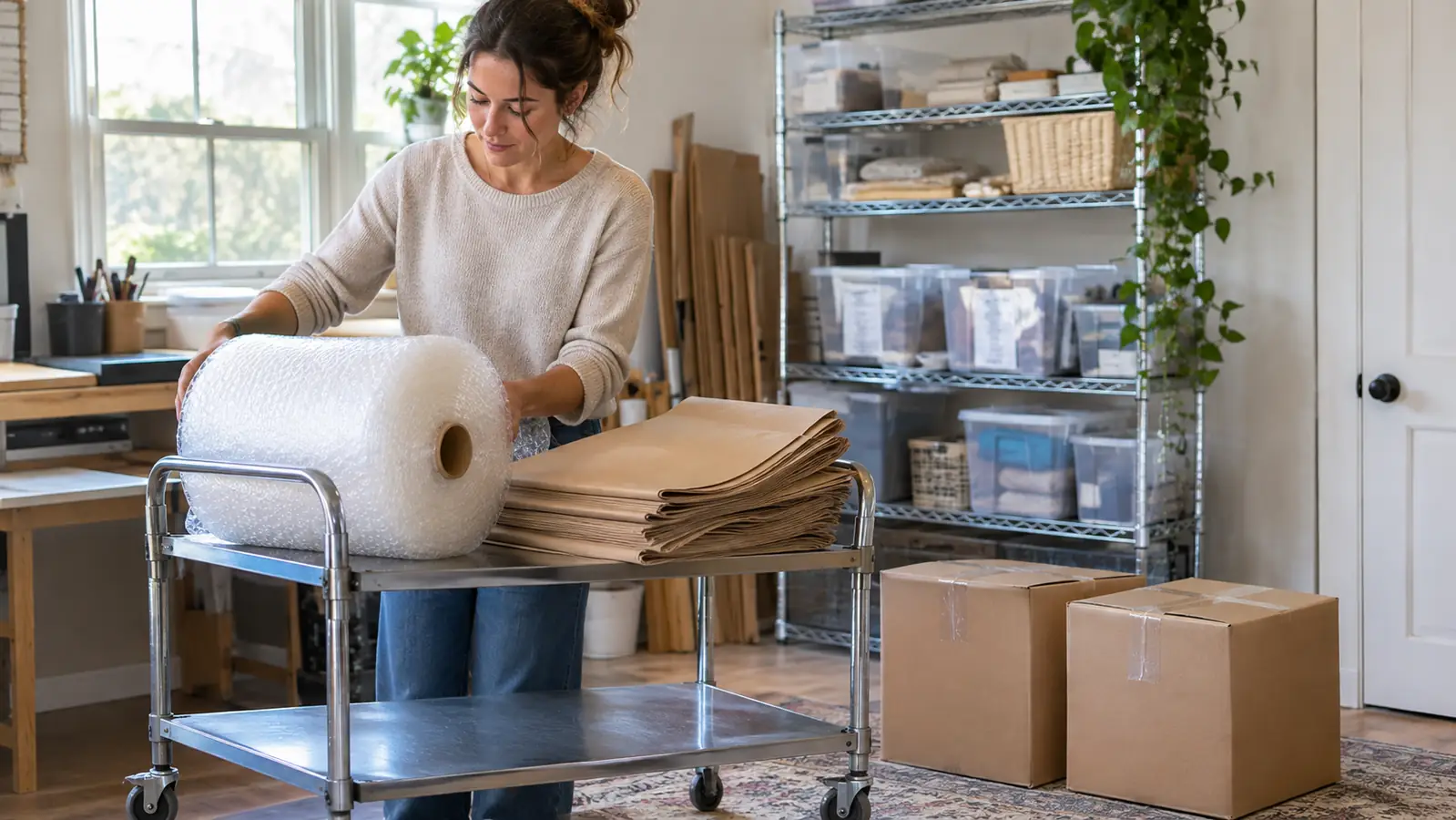
Here is the sequence at my folding table, and it uses both materials in the order that works. I put a layer of crumpled paper in the bottom of the box, about an inch deep, so the item is not sitting on bare cardboard. I wrap the glass in the bubble wrap, bubble side in, two turns around a bowl and a little extra at the rim where a chip always starts. I set it in, then I crumple paper and push it into the corners until the wrapped piece cannot move when I shake the box gently. Then tape, with the tape gun, because a bare roll hurts.
Take a box I packed on a Tuesday in October, a set of four ironstone plates and a gravy boat, going to a buyer in Oregon. The plates were 9 inches across, so a 12 inch sheet folded over each one with an inch of overhang on every side. I wrapped each plate separately rather than stacking them, because stacked plates rub against each other no matter how much paper sits between them and the glaze goes first at the rim. Two plates, then a doubled sheet of paper, then two more plates, then the gravy boat wrapped on its own with extra turns around the spout. The box was 14 inches square and it took three crumpled sheets to stop everything moving. I shook it next to my ear. Nothing shifted. That is the test, and it is the only test I trust.
The rules behind that sequence are simple. Glass never goes in a poly mailer, and clothing never goes in bubble wrap, so the two supplies do not overlap much in my shipping room. If a box is mostly glass, it gets more bubble wrap and less paper. If it is one bowl going out with a pair of jeans, the bowl gets the bubbles and the jeans get the space around it. Packing paper is there to stop motion. Bubble wrap is there to absorb impact. A parcel needs both jobs done, and no single material does both well.
The one thing I would change if you are starting out is where you spend first. Buy the bubble wrap before you buy anything else for fragile items, even if paper is what you reach for most often by volume. A paper failure is annoying. A bubble failure is the one that costs you a sale, a refund, and a piece of Pyrex you cannot replace.
Who Should Buy Which
Buy Duck bubble wrap if you sell anything with a glaze, a rim, or a screen: ceramic, glass, framed art, lamps, mirrors, or dishes of any kind. Buy it if you have had even one breakage in the last year, because that is the case it is built for. Buy the packing paper if your inventory is soft goods, books, or shoes, or if you simply need a cheap way to fill the top two inches of a box that is already protected inside. Most sellers need both, in different amounts.
If you are not sure which side of this you are on, look at what you have lost. In my first year I broke a bowl, and I paid for it twice, once in the refund and once in the piece itself. After that I stopped guessing. A roll of the Duck wrap lives on the lower shelf at all times and I reorder when I am down to the last few feet, which at 8 to 15 packages a week works out to roughly every two months. The paper I buy in a bigger stack and I do not track it at all, because running out of paper is an inconvenience and running out of bubble wrap in the middle of a set of dishes is a problem.
If you can only keep one on the shelf, and you ship breakable things more than once a month, keep the bubble wrap. Paper is available in any grocery store in a pinch and it is the material you can substitute. There is no substitute for a cushion. And if you never ship anything that can crack, you can skip this entirely, because paper and a good tape job will carry a box of sweaters across the country without complaint.
Wrap the glass in bubbles. Fill the air with paper.
12 inches wide, 175 feet per roll, perforated every 12 inches, and 1.1 pounds for the whole roll so it will not push a parcel over a weight break. This is the Duck wrap I have bought since January 2022, and the reason nothing glass has broken since.
Amazon Check Today's Price on Amazon →