
Twice in the fall of 2021 I opened a box in my shipping room and heard glass move when it should not have moved. The first time it was a Butterprint refrigerator dish with a crack running up from the rim. The second was a stack of four custard cups, and two of them came out in pieces. I had been wrapping in newspaper because that is what my mother did and because it was free. In January 2022 I bought Duck small bubble cushioning wrap instead, and I have bought it ever since. Nearly five years. I have not had a dish break in transit since.
This is not a piece about saving money. Prices move and I am not going to quote one. It is about what the roll does when a Fire-King mug with a thin handle has to get from Ohio to Oregon in a box with three other mugs, and whether that is worth keeping a roll on the cart for five years. It is.
The Quick Verdict
Small bubbles that sit down against rims, feet and handles instead of bridging over them, a tear every 12 inches so you never need scissors, and 175 sheets on the roll. This is the wrap I reach for when the piece is older than I am.
Amazon Check Today's Price →The roll that ended my broken-dish streak
Duck small bubble cushioning wrap, 12 in x 175 ft, perforated every 12 inches. Wrap bubble side in, tear the sheet by hand, tape it shut.
Amazon Check Today's Price on Amazon →How I've Used It
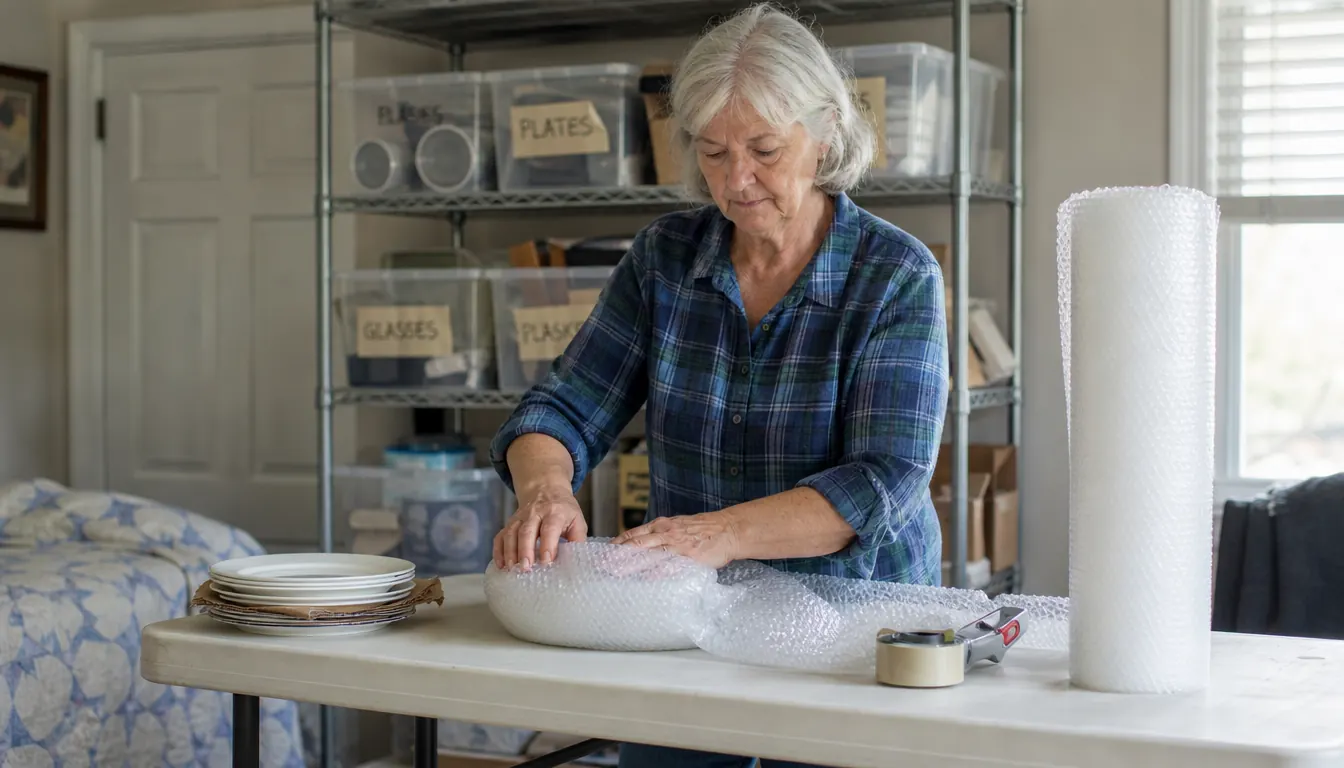
The shipping room is the second bedroom. There is a six-foot folding table I stand at, a wire shelving unit with labeled bins, and a rolling cart that holds supplies. The Duck roll lives on the bottom shelf of that cart, standing upright. I buy the 12 inch by 175 foot roll and one lasts me six to eight weeks at my usual eight to fifteen packages a week, and less than that in November and December when the volume doubles.
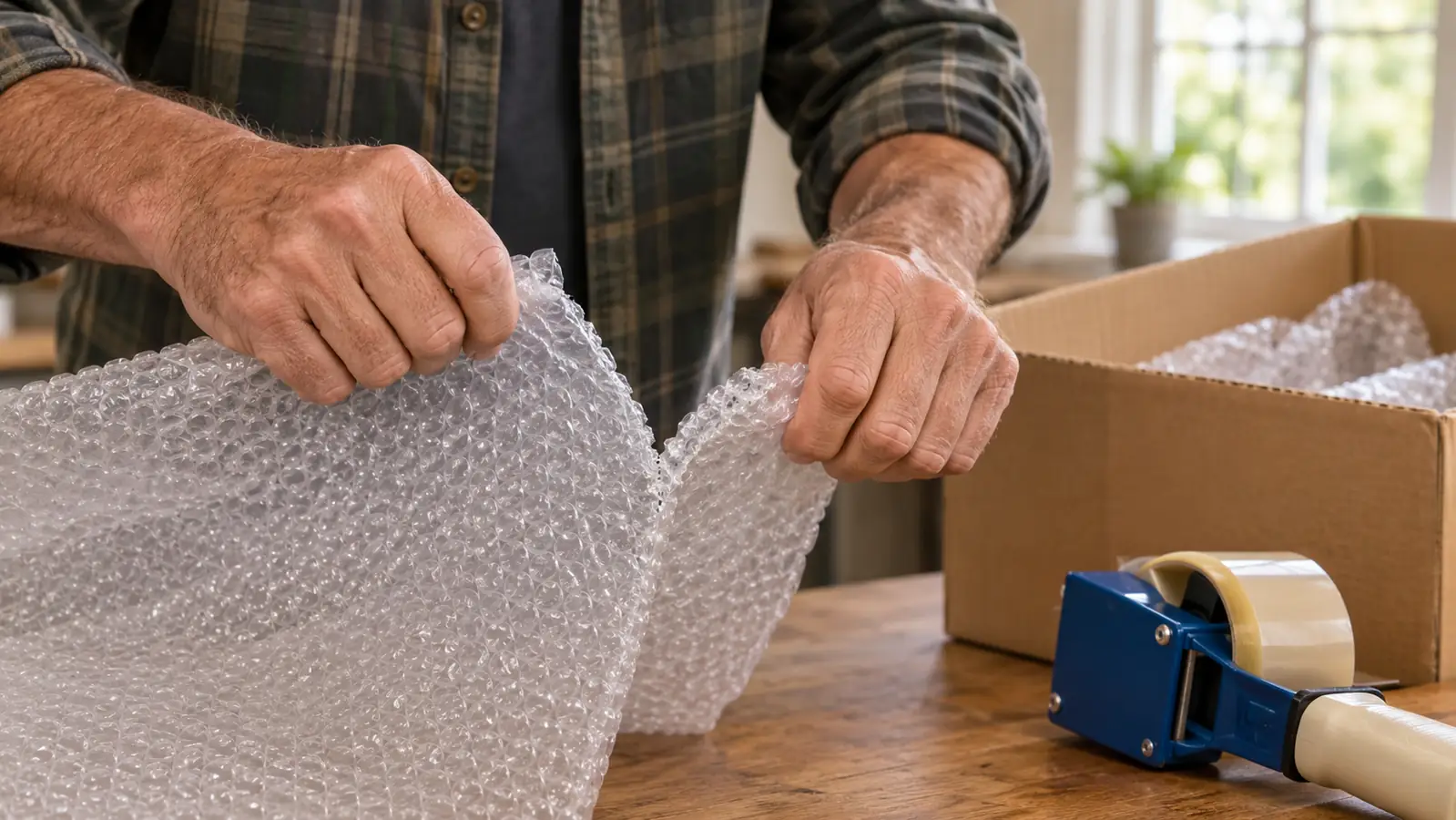
The method has not changed in five years. I pull a length off the roll, tear it at the perforation, and lay the item on the sheet with the bubbles facing the glass. Bubble side in, flat side out, every time. The flat side gives the tape something to grab and slides against the next wrapped piece in the box. The bubbles are what touch the china.
A mug takes one sheet, rolled and then folded in at the ends. A 1.5 quart mixing bowl takes two sheets crossed and a third around the rim. A plate takes two. Anything with a spout, a Hall teapot or a creamer, takes three or four, and I spend the extra minute on the spout, because the spout is the part that snaps off and it is also the part that makes the piece worth listing in the first place.
For the first two months I over-wrapped everything, four or five sheets on a single mug, and I burned through a roll in three weeks. The correction was not more wrap. It was a smaller box. Once the wrapped piece fits with about an inch of clearance on every side and cannot slide, three sheets do the work five were doing.
I also wrap before I photograph, which is backwards from most of the advice and right for me. A wrapped piece sitting on the table tells me whether the box is going to be heavy on one end when I lift it. I have repacked at the table more than once because the weight was in the wrong corner.
What I Tried Before This
Newspaper was the first thing, and it fails for a reason that has nothing to do with cushioning. It compresses. A wad of newsprint around a bowl holds its shape for about a day in a moving truck and then it does not, and the bowl starts to shift. It also leaves ink on the glaze, and on a piece of vintage china ink is a real problem. I dulled the finish on a saucer that way and had to keep it rather than list it.
The large bubble material was the second attempt. It is not worse material, it is the wrong shape for what I ship. Big bubbles bridge. Lay it over a curved surface and it touches at the high points and leaves a gap at the rim, the foot ring and the handle, which are the three places a piece actually breaks. I still keep a partial roll for one job, wrapping the outside of a box that is going a long way, and that is all I use it for.
Foam sheets were the third. They work, they are clean, and they add weight and bulk to every box, which matters when you weigh on a counter scale and pay by the pound. I also found that a foam sheet wants to stay flat while a small bubble wrap will fold into a shape and stay folded. For a teapot, that difference is most of the job.
What the Small Bubbles Actually Do
A custard cup is the clearest demonstration I can give you. It is small, thin walled, and it has a foot ring. Wrapped in the large bubble material, the foot ring sits in a gap and the cup can shift inside its own wrapping. Wrapped in the small bubble material, the wrap follows the taper of the cup and the foot and holds it. After about the third box I stopped using anything else on cups.
The manufacturer describes the small bubbles as allowing easy conformability around delicate and valuable items, which is a marketing way of saying the wrap sits down against the shape instead of standing off it. That is what you are paying for. Not thickness. Contact.
The second thing they do is not cost you at the counter. The whole roll weighs 1.1 pounds and a sheet of it weighs close to nothing. I weigh every box on an Accuteck 8250 before I print the label, and on a four-mug box the wrap does not move the number enough to notice. That is not true of foam and it is not true of a double layer of the large bubble.
The material is nylon, and it does not shred. The paper I used to use tore along a fold and left lint on everything. This does not, and it is see-through enough that I can look at a wrapped bowl and still catch a chip in the pattern before the box is closed. I have caught two that way.
Taping matters as much as the wrap. I tape the seam of the wrap itself, not just the box, because a sheet that comes loose in transit is a sheet that is no longer doing anything. One strip across the seam and one around the middle of a bundle is enough with a 2 inch tape gun.
For boxed sets, two wrapped pieces can nest against each other if you put a flat sheet between them and tape the pair as one bundle. I do that with stacking bowls and with a set of four cups. It stops the pieces from grinding on each other, which is the failure that does not break anything but does leave a ring of abrasion marks on a glaze.
The Perforation Is the Feature I Use Most
Perforated every 12 inches sounds like a line item on a listing. It is the reason I keep buying this roll instead of a plain continuous one. A 12 inch wide roll with a tear every 12 inches gives you a square of wrap per sheet. A mug takes one. A cereal bowl takes one. A dinner plate takes two. A teapot takes four. I tear a sheet with two hands and no tool, which would have been convenient at forty and is close to essential now that my right thumb has opinions.
Tearing is also faster than cutting. In December I am not putting a dish down to pick up scissors forty times an hour. Pull, tear, wrap, tape, box, weigh, label, and the roll goes back on the cart.
Nearly five years of Pyrex, Fire-King and custard cups through the mail, and the only broken dish I have had was the one in the fall before I switched.
Weight, Bulk, and the Spare Room Math
The roll is 175 feet, which is 2,100 inches, which at a tear every 12 inches is 175 sheets. A four-mug box uses about six. A box with a mixing bowl and two small dishes uses about ten. So a roll covers somewhere around twenty to twenty-five glass boxes, and at my volume that is six to eight weeks. I keep one spare on the cart shelf and reorder when I open it, not when it runs out.
The roll takes up about as much shelf as a bottle of wine and it does not need a dispenser. There is no cutter to mount, no bracket, no wall space used. That matters in a spare bedroom where the table is the only clear surface and the shelving is already full of inventory bins.
One handling note. If you pull the roll flat off the shelf it will telescope and unspool half a length more than you wanted. Stand it upright and pull upward. That sounds fussy until you have wasted four feet of wrap three sessions in a row.
The last few feet of a roll are the awkward part. The perforation still works but the roll gets light and wanders, so I finish it on small items, mugs and saucers, and open the fresh one for anything with a spout.
What I Liked
- Small bubbles sit against rims, feet and handles instead of bridging over them
- A tear every 12 inches, so a sheet comes off by hand with no scissors
- 175 sheets on the roll, and one sheet covers most mugs and bowls
- The whole roll weighs 1.1 pounds, so it barely moves the number on the scale
- Nylon material does not shred or leave lint on a glaze
Where It Falls Short
- It is cushioning, not structure. A heavy bowl still needs a snug box
- One roll does not survive December. Keep two
- A loose roll telescopes if you pull it flat instead of upright
- Wrong material for clothing orders, which go in poly mailers
The Tradeoffs
Bubble wrap is not a box. It manages shock and abrasion. It does not stop a box from being crushed and it does not stop a heavy piece from moving if the box is too big for it. On a covered casserole or a stack of plates I wrap in this and then pack the bundle tight, with no more than an inch of clearance on any side. The wrap does its part and the box does the rest.
Handles deserve their own note. A teacup handle and a pitcher handle both stick out, and both are what breaks. I wrap the handle separately with a small torn piece first and then do the whole piece. It takes an extra twenty seconds and it is the single change that stopped handle breaks for me.
The second tradeoff is that it is one material on a cart that holds several. Glass goes in boxes with this. Clothing goes in Metronic 10x13 poly mailers with a self-seal strip, and there is no reason to put bubble wrap inside a poly mailer. If you sell only clothing, this roll is not your supply.
The third is that small bubbles are small. On anything large and rigid, a lamp, a shelf, a frame, they are the wrong tool and no number of layers fixes it. That job wants foam and a proper box.
Who This Is For
This is for someone shipping glass, ceramic or anything with a handle, a spout or a foot ring, out of a house rather than a warehouse. The perforation is what makes it work at a folding table with no room for a mounted cutter.
Volume is worth mentioning. At eight to fifteen packages a week you can pack by hand with a roll and a tape gun and never feel slow. If you are doing a hundred a day you want a dispenser and a different workflow, and nothing in this review applies to you.
It is also for anyone whose hands are not what they were. I will not pretend a roll of bubble wrap is ergonomic equipment, but tearing a perforated sheet is easier on a thumb than cutting forty sheets with scissors, and it is a great deal easier than wrestling large bubble around a plate.
Who Should Skip It
Skip it if everything you ship is soft. A sweater does not need this and neither do jeans.
Skip it if you are shipping furniture, lamps with long stems, or anything large and rigid. Small bubbles conform to small shapes. A tall lamp needs a box, foam and void fill, and this roll will not get you there however many layers you use.
I would also skip it if you are packing to move a house rather than shipping individual orders. Moving boxes get handled differently, and a whole kitchen wants dish packs and far more material than one 175 foot roll.
And skip it if you want one supply to cover every order. This is one tool on a cart that holds four or five, next to the scale and the printer.
The roll I reorder before it runs out, not after
Duck small bubble cushioning wrap, 12 in x 175 ft, perforated every 12 inches. Bubble side in, flat side out, tear it by hand and tape the seam.
Amazon Check Today's Price on Amazon →