
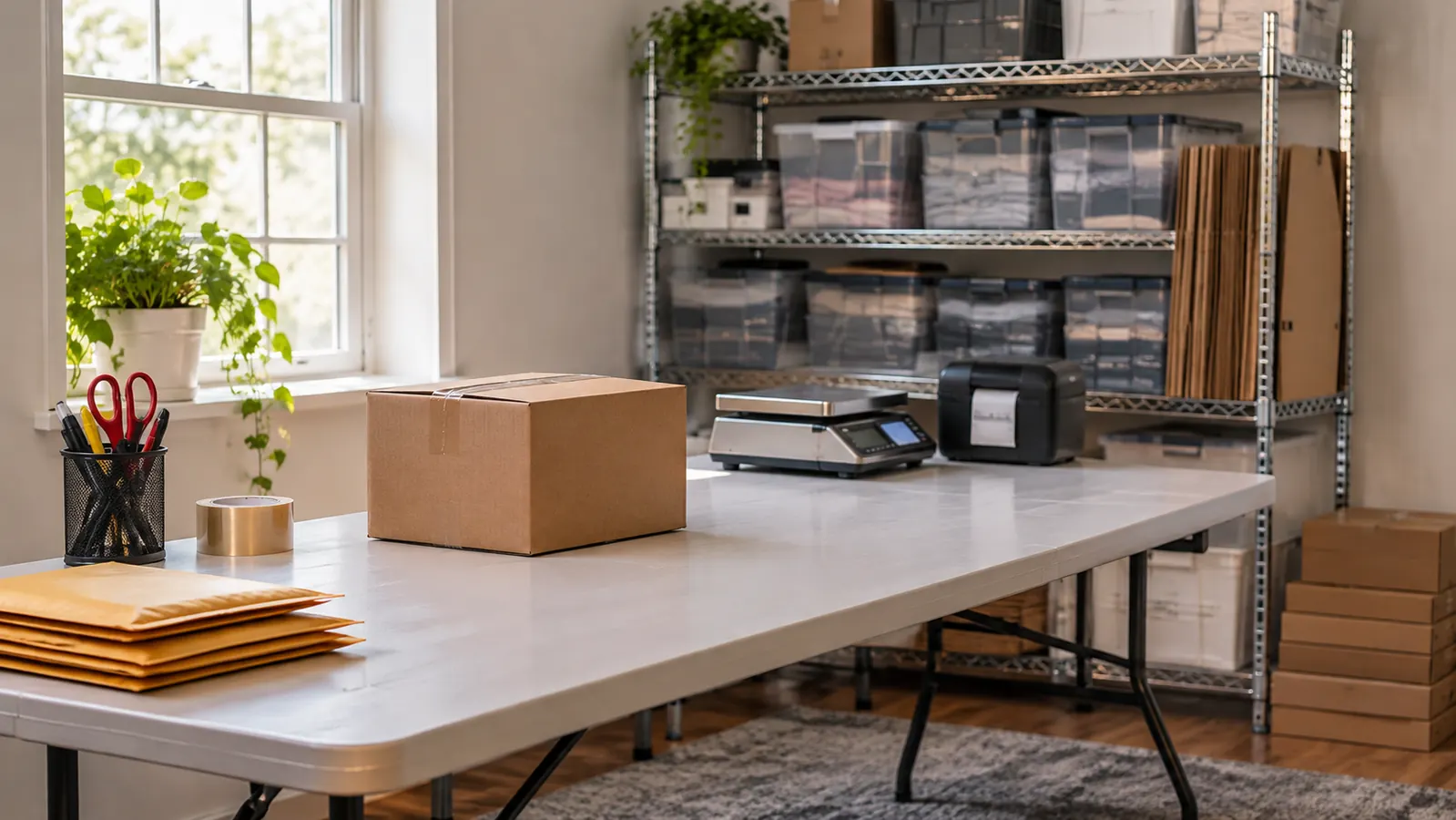
Two packages came back to me in the same week in the fall of 2021, both stamped postage due. I had guessed the weight at the counter, the clerk had weighed them properly, and I paid to send them a second time. I spent 27 years behind a post office counter before I retired. I knew better. Knowing better and doing better are different things, and the gap between them is usually a missing tool. For me that tool was a scale. Mine is the ACCUTECK 8250, bought in January 2022, and it has sat next to my label printer ever since.
What follows is not a pitch dressed up as a list. It is an honest accounting of what changed in my spare bedroom shipping room once I stopped guessing. I pack 8 to 15 packages a week, more in November and December, mostly thrifted clothing, shoes and vintage kitchenware. Every reason below is something I ran into at my own folding table.
The first piece of equipment I would buy again tomorrow
The ACCUTECK 8250 has been on my table since January 2022. Fifty pound capacity, reads to 0.1 oz, tare and hold buttons, backlit LCD, and it runs on AAA batteries or the included AC adapter.
Amazon Check Today's Price on Amazon →Ends the postage-due return before it happens
The first thing a scale buys you is the end of one specific bad day. You print a label, tape the box, hand it to the carrier, and three days later it comes back with a sticker on it because the weight was short. That happened to me twice in 2021. A scale collapses the whole loop into one reading you take before the tape goes on. Weigh it, type it, tape it. I have not had a postage-due return since January 2022.
Turns a guess into a number you can write down
Guessing feels faster. It is not, because a guess does not survive contact with a receipt. Once the weight is a number, it goes on the listing, on the packing slip, and into the label field without a second thought. I write the weight on the top of each bin label now, so a sweater listed for months keeps the same shipping weight in my head and in the listing. Nothing drifts. Nothing gets re-guessed at eleven at night when I am tired and the tape is running out.
Reads to a tenth of an ounce, which matters more than it sounds
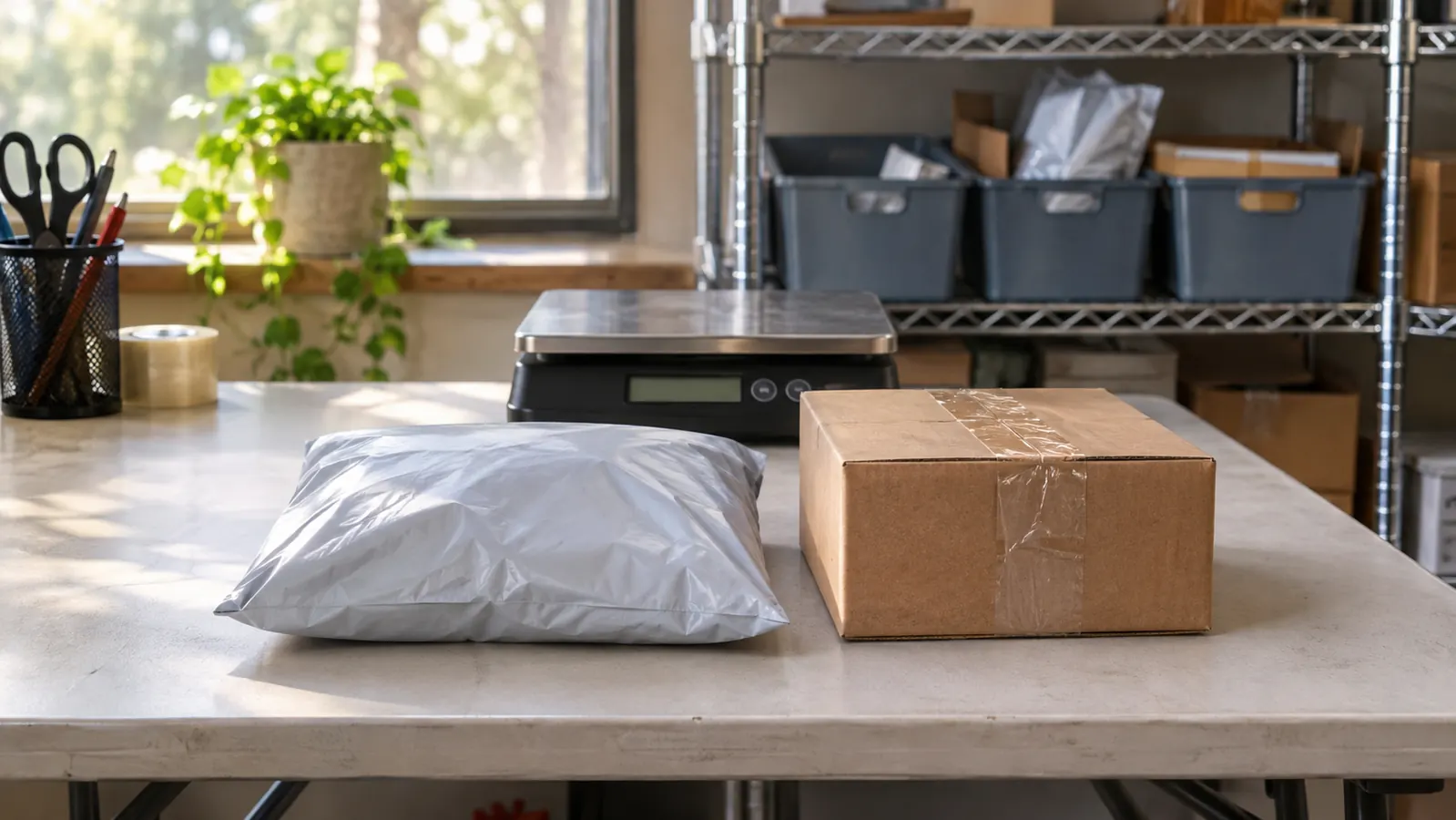
The 8250 reads to 0.1 oz. That precision is the difference between one blouse pricing at one rate and the same blouse with tissue and a poly mailer pricing at the next tier up. On a light item, a couple of ounces is the whole spread between one shipping bracket and another. A scale that only reads whole ounces rounds in one direction, and it is never your direction. I weigh everything, including the light stuff, because the light stuff is where the rounding bites.
The tare button subtracts the box for you
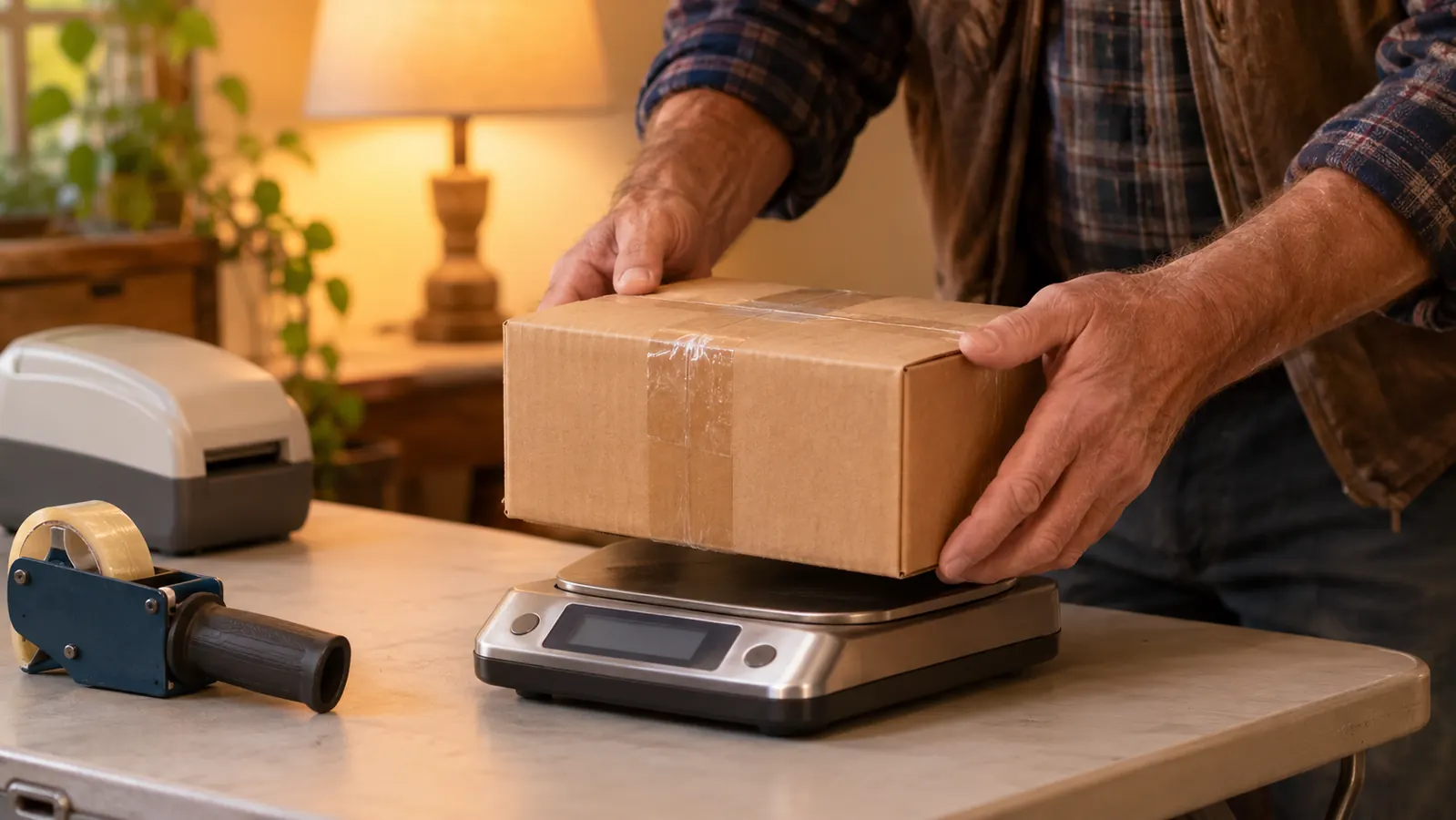
Here is the arithmetic a scale deletes. Empty box on the platform, press tare, the display goes to zero, load the item. What you read is the item and the packing material, not the carton. I used to weigh the box, write the number on the flap in marker, and subtract on the back of a packing slip. That is three chances to get it wrong per order, and I did it for most of a year. The tare button is the feature I use most, and it is one button.
Fifty pounds of capacity covers anything I will ever pack
The heaviest thing I ship is a box of stacked stoneware, maybe fifteen pounds with cushioning around it. Fifty pounds of capacity means I never think about the limit, never stack two readings to get a total, and never wonder whether the platform is straining. Headroom on a counter scale is not about shipping anvils. It is about a full box of dishes landing squarely on the platform and reading the same number twice.
The hold function reads around the corner of a big box
Set a box on a counter scale and the box is between your eyes and the display. The hold function locks the reading so you can slide the box off and look. I use it on every box bigger than a shoebox, which is most of what goes out of here in December. Small feature, mentioned in one line of the listing, and it is the difference between reading a weight and guessing at one from an angle.
A backlit LCD you can actually read at six in the morning
I pack early. The lamp in the shipping room is behind me, so the scale sits in its own shadow, and a plain grey screen in a shadow is a guessing game. The backlit LCD on the 8250 is legible from standing height in a dim room. It is a boring thing to care about and I care about it every single morning from October through December.
The AC adapter means it is ready when you are
The ACCUTECK came with both an AC adapter and AAA batteries, and I keep it plugged in. That is a small decision with a large payoff: there is no morning where I have to hunt for batteries before I can print a label. Nearly five years in, the adapter is still the one it shipped with and the scale lives on the same corner of the folding table, next to the printer.
Auto shut off means it is not quietly draining batteries
Auto shut off is the feature you never notice and would absolutely notice if it were missing. Walk away, the display goes dark, set something on the platform, it wakes up. I have replaced the batteries maybe twice since 2022, and both times because I unplugged the scale to rearrange the table. For a tool that sits idle most of the day, that is exactly the behavior you want.
Accurate listings mean fewer messages from buyers
When the weight in a listing is wrong, you find out in your inbox. Buyers ask why shipping looks high, or the label comes out short and you eat the difference. Once the number came off the scale instead of out of my head, those messages mostly stopped, and the shipping line on my listings matched what the label actually said. That is the quiet payoff of a boring tool. Nobody thanks you for it. It just stops being a problem.
What I'd Skip
Skip a kitchen scale. It reads light and it reads small, but the platform is the size of a saucer and the capacity tops out well below a full carton, so you end up balancing a box on it and hoping. Skip the hanging scales with a hook, which are fine in a mail room and awkward at a folding table. Skip a big platform scale rated for a hundred pounds or more; you pay for capacity you will never use and give up counter space you do not have. And if you are buying one thing this month, buy the scale before the label printer. A printer working from a guessed weight just prints the wrong postage faster.
Nearly five years, thousands of labels, and the scale has never once been the reason a package came back.
Weigh it once. Stop paying for the same mistake twice.
The ACCUTECK 8250 reads to 0.1 oz, holds up to 50 lb, and runs on the included AC adapter or AAA batteries. It has been on my folding table since January 2022 and I have never found a reason to replace it.
Amazon Check Today's Price on Amazon →