
Two packages came back to me in the fall of 2021 stamped postage due. Both were sweaters. Both were light. Both had been weighed by my best guess at the post office counter, and my best guess was off by just enough to matter. The buyer pays the difference on their end, you get a polite but cool message about it, and there is nothing to do but apologize and eat the postage. That is a bad way to learn that guessing is not a shipping method.
So in January 2022 I bought the ACCUTECK 8250 High Accuracy Digital Shipping Scale. It was the first piece of real equipment I bought for this business, ahead of a label printer and well ahead of a tape gun that did not hurt my thumb. Nearly five years later the ACCUTECK sits in the same spot on my six-foot folding table, plugged into the same outlet, and it gets used on every single order that leaves the shipping room. Thousands of packages. Not one postage due notice since.
The Quick Verdict
Accurate to a tenth of an ounce, simple enough to run half asleep, and still working after nearly five years of daily use. It is a counter scale that shows a number and does nothing else, which is the whole reason I like it.
Amazon Check Today's Price →The scale that ended my postage due notices
Fifty pound capacity, a readout to 0.1 oz, tare and hold buttons, and it runs on the included AC adapter so it never needs batteries. This is the ACCUTECK model I have kept plugged in since January 2022.
Amazon Check Today's Price on Amazon →How I've Used It
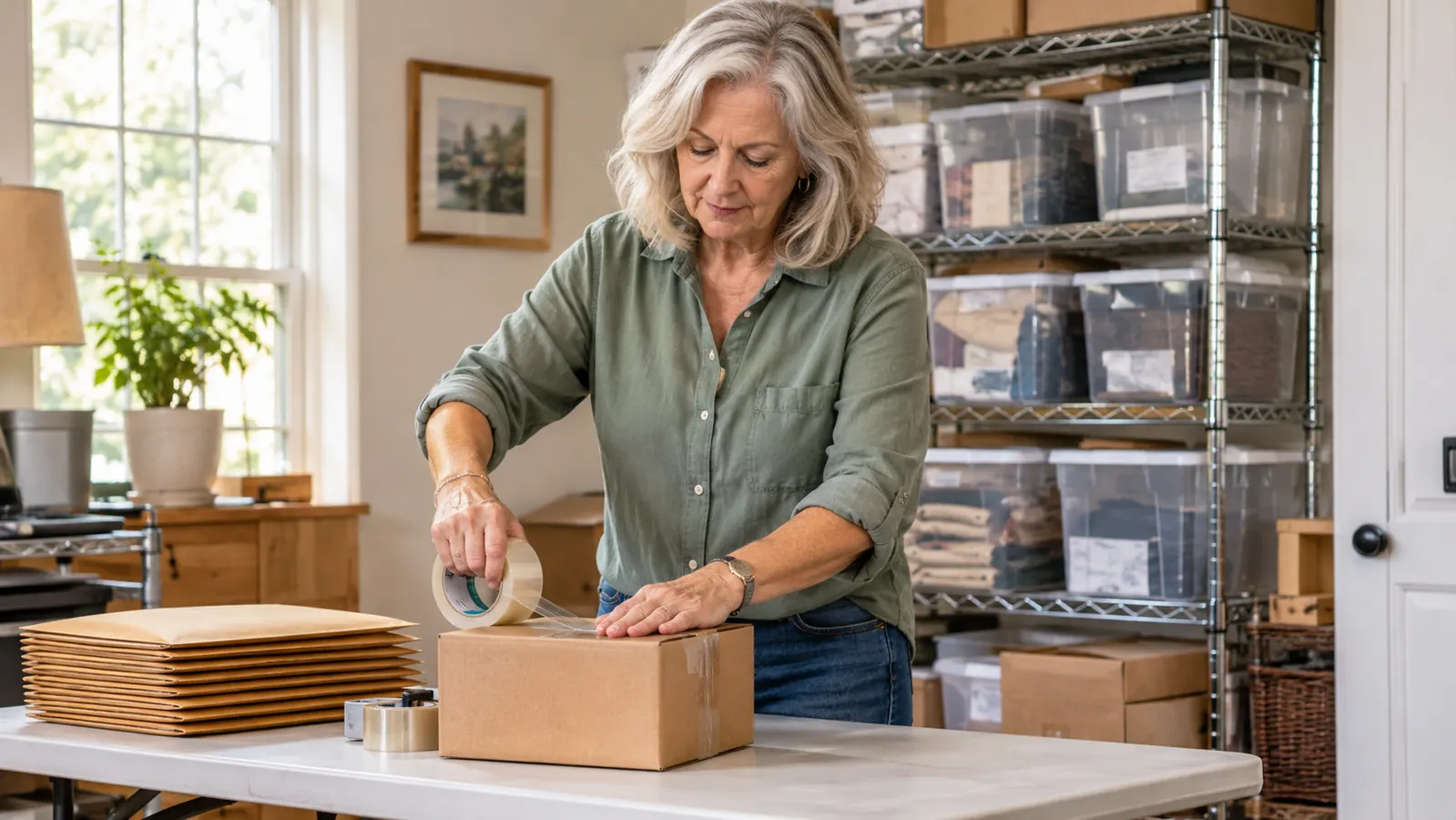
The shipping room is the spare bedroom at the front of the house. There is a six-foot folding table under the window, a wire shelving unit against the wall with labeled bins for inventory, and a rolling cart that holds tape, mailers and bubble wrap. Gene carries the finished boxes out to the porch for carrier pickup and otherwise stays out of the room, which suits us both.
The scale sits at the right end of the table, next to the label printer. The routine has not changed since the winter I bought it. I pack the item, set the box on the platform, wait for the number to settle, write it on the corner of the box in marker, and type that weight into the listing when I print the label. Clothing goes into a poly mailer, which I weigh empty first and tare out. Glass and dishes go into a box with bubble wrap, and I weigh the whole thing packed.
I drop at the post office counter or schedule a free carrier pickup from the porch, so I do not have the option of eyeballing something and letting a clerk catch it. The number on the display is the number that goes on the label. Postal rates move around every year and the zones move with them, but the weight is the one part of the calculation I have not had to think about for nearly five years. The ACCUTECK did that, and it did it without asking anything of me beyond a flat surface and an outlet.
The 0.1 Ounce Readout Is the Whole Point
Postage rounds up. That is the thing people miss. A package that comes in at fifteen and a half ounces is not billed at fifteen and a half ounces, it is billed at the next tier up, and the gap between one tier and the next is where a light sweater becomes a heavier sweater for pricing purposes. Guess high and you hand over money you did not need to spend. Guess low and the package comes back.
A tenth of an ounce is a small enough unit that I can stop guessing. The listing gives the readout accuracy as 2.86 grams, which is the same thing stated the metric way. What that means at my table is that a folded blouse and a folded blouse with a tissue layer read differently, and I can see it, so I pack accordingly instead of hoping.
Here is the example I use when someone asks why the decimal matters. A pair of jeans in a poly mailer lands somewhere around a pound and two ounces, and the same jeans with a leather belt rolled in and a second layer of tissue land at a pound and six. Under one rate structure those are the same package. Under another they are not, and the difference is four ounces I would otherwise be guessing at. I do not guess at four ounces anymore.
It also settled an argument I had been having with myself about shoes. A pair of leather loafers feels heavy in the hand and is heavy on the scale, and before I had a real number I was padding every shoe order with extra postage out of pure nerves. I was overpaying on a lot of them. I would rather not say for how long.
Tare and Hold: The Two Buttons That Do the Work
Every mailer, every box, every padded envelope has weight of its own, and that weight is not free. The tare button zeroes the scale with the empty packaging on it, so the number that comes up is the item and nothing else. Press it with the poly mailer on the platform, fill the mailer, read the weight, done. It takes about a second and it keeps me honest on nearly every order I ship.
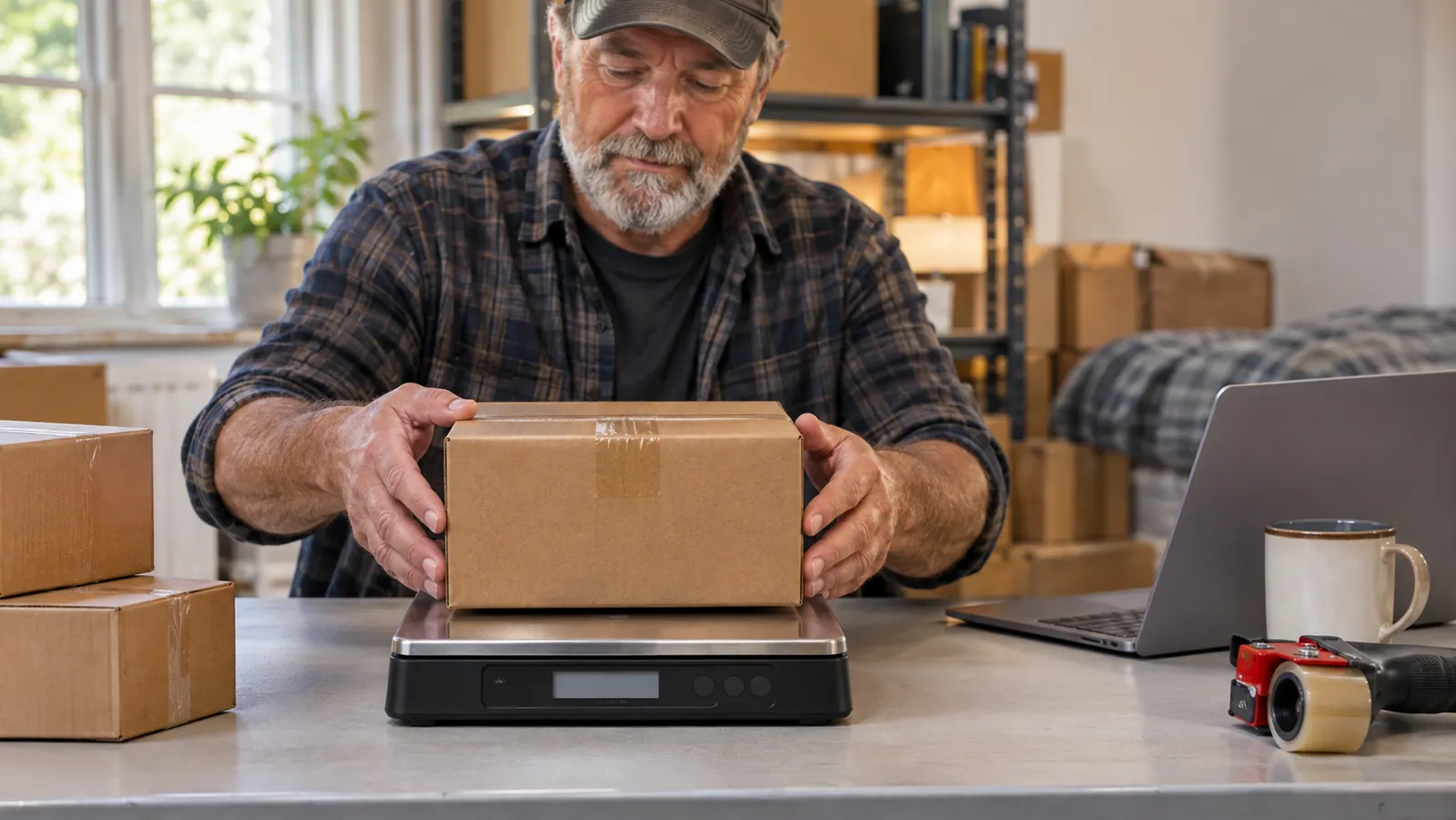
The hold function is the one I did not expect to use. On a big box the platform is not large enough for the whole carton to sit flat and still leave the display visible, so I set the box down, let the reading settle, and press hold. The number locks and I can slide the box off and write it down. The listing describes it as locking readings for larger boxes, and that is an accurate description of what it does.
Before I used tare, I did the arithmetic in my head. Weigh the empty box, write it down, weigh the packed box, subtract. It is not hard math, but it is math done while holding a roll of tape under one arm, and I got it wrong often enough to notice. Now the scale does it, and the number on the label is right the first time.
My right thumb has some arthritis in it, and I mention that because it changes what equipment I recommend. The buttons on this scale are light to the touch and I do not have to press hard or aim carefully. I cannot say the same for the tape gun I owned before the current one. A scale that needed a firm press would be a scale I would start avoiding, and avoiding the scale is how you end up guessing again.
Packing Glass and Dishes: Where It Earns Its Keep
Vintage Pyrex is the reason I started weighing properly. In late 2021 a bowl arrived in pieces. The packing was the problem, not the scale, but the whole episode made me look at the shipping room differently. Since I started wrapping with small bubble wrap, bubbles facing in, and weighing the finished box instead of estimating it, I have not had a dish break in transit.
Glass goes into a box with padding on all six sides, and the packed weight runs higher than people expect. A single covered dish can come in over two pounds once it is properly wrapped. That number decides the box size, the padding and the label, and it is the difference between a careful job and a hopeful one. I weigh the box with the lid closed and the tape on, because tape and a label are weight too, and at the margins they count.
The fifty pound maximum is more than I will ever need. My heaviest shipment in nearly five years was a boxed set of stoneware that came in just under fourteen pounds. But capacity is not why I bought it and it is not why I would buy it again. The readout is.
What I Tried Before This One
The first thing I used was the kitchen scale, which is a sentence that should embarrass me more than it does. It was small, it maxed out well below anything I was shipping, and the platform was too narrow for a box, so I was balancing cartons on it and squinting at a display that went dark while I was still reading. A kitchen scale is built to weigh flour. It is not built to weigh a sweater in a mailer with a tissue layer and a return label.
What made me move up was the capacity, plainly. I needed something that could take a carton without me holding it, and I wanted a display I could read standing up. The ACCUTECK 8250 answered both. There is no setup beyond putting it on the table and plugging in the adapter, no pairing, no calibrating ritual, no menu to learn. I unpacked it in January 2022, set a full roll of tape on it to see the number come up, and started weighing orders that afternoon.
I have since looked at the scales with a detachable display on a cord, and I understand the appeal for anyone weighing really large cartons all day. I do not ship those. For clothing and housewares out of a spare bedroom, the plain counter scale is the right amount of machine.
What Has Held Up After Nearly Five Years
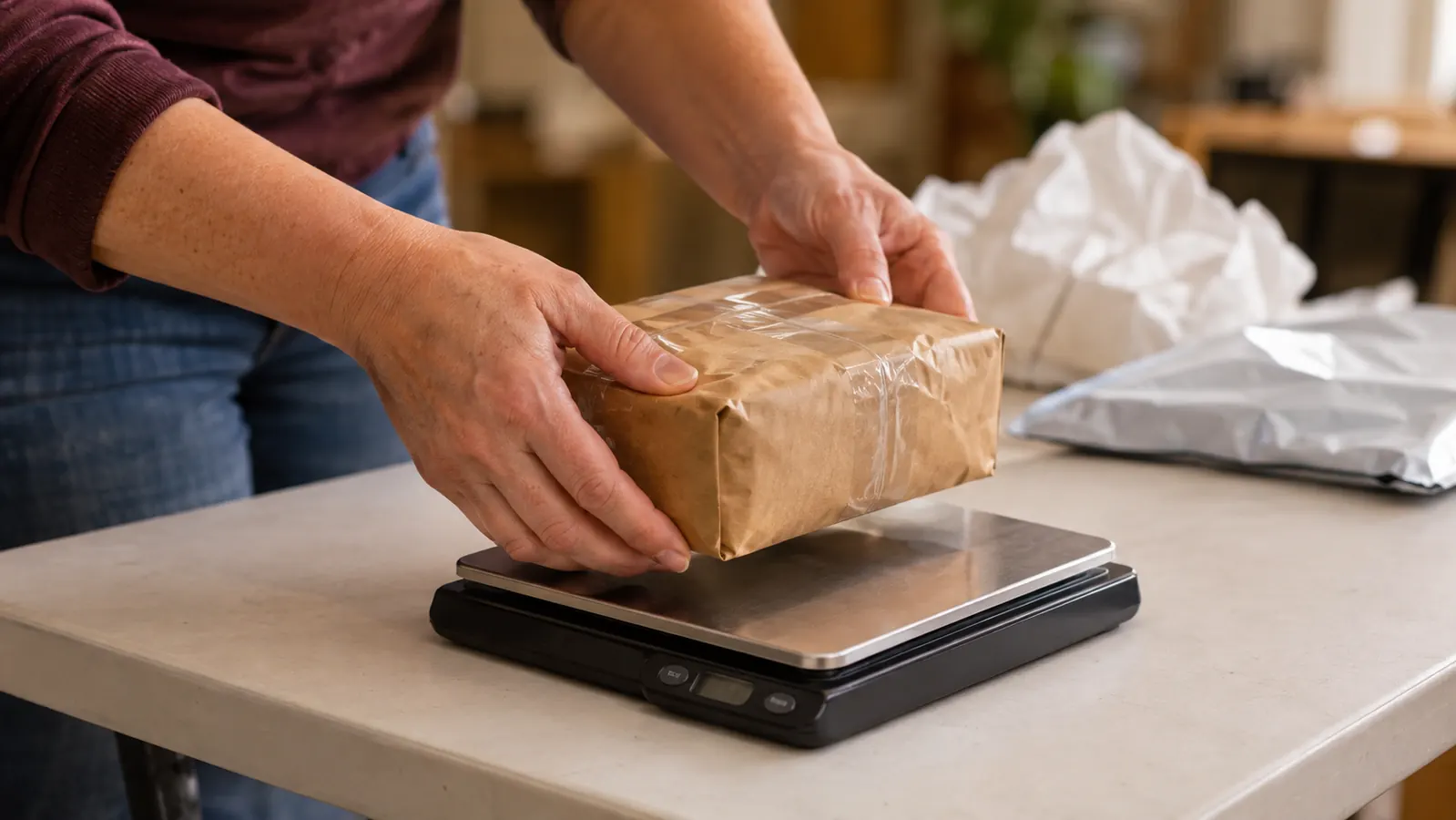
Nothing has broken. The platform is level, the feet are still on it, and it reads the same as it did in 2022 as far as I can tell. I check it now and then against a five pound bag of flour from the kitchen, which is a habit left over from twenty-seven years behind a post office counter, and it has never been off by enough to notice. The LCD is still bright. Nothing has gone dim.
The AC adapter is the reason it has lasted, I think. The ACCUTECK has been plugged in continuously since the first week, so the AAA batteries are a backup I keep in the drawer and rarely touch. Dual power is one of those features you do not appreciate until the outlet is behind a shelving unit, and then you appreciate it a great deal.
What has not held up is nothing, which makes for a dull section, so I will tell you the annoyances instead. It weighs in kilograms, in pounds and ounces, and in plain ounces. It does not weigh in grams, which matters if you sell anything buyers ask about in grams. It also wants a flat hard surface. I set it on a padded mat once to quiet the clunk of boxes and the readings wandered until I moved it back to the bare table.
I have thought about what I would do if it died tomorrow. I would buy the same model again, which is the plainest compliment I can pay a piece of equipment. Not because it is fancy, since it is not, but because after nearly five years I know exactly where everything is on it and I do not want to learn a new one during the December rush.
What I Liked
- Holds a reading to a tenth of an ounce, so rounding up is a decision instead of a gamble
- Tare zeroes out mailers and boxes, which matters on every light order
- Hold function locks the number on boxes too big to leave sitting on the platform
- Fifty pound capacity covers anything I have ever shipped
- Runs on the included AC adapter or AAA batteries, so it works anywhere on the table
- Backlit LCD is readable in a dim spare bedroom at seven in the morning
- Still accurate after nearly five years of daily use
Where It Falls Short
- No grams setting, only kilograms, pounds and ounces
- Needs a flat hard surface and drifts on anything soft
- Auto shut off means a fresh power up between orders
- Platform is small for oversized cartons, which is why the hold button exists
- I have found no stored history, so my record keeping is still a clipboard
I have not had a package come back postage due since January 2022. That is the review, really. Everything else is detail.
Living With It: Power, Shutoff and the Small Stuff
The auto shut off is the only thing I notice day to day. If I weigh something, get distracted by a message about a stain on a blouse, and come back ten minutes later, the display is dark and I have to tap it awake. That is a two second inconvenience, and it is part of why the thing still runs on the same adapter. I would not trade it.
The scale itself weighs two pounds, so it moves easily when I need the table clear for photographing inventory. I pick it up by the platform, set it on the shelf, and put it back when I am done. It does not need fiddling to settle after a move, which was not true of the kitchen scale I gave up on in the early days.
Who This Is For
If you sell online from a spare room or a corner of a garage and you ship somewhere between a handful and a few dozen packages a week, the ACCUTECK 8250 is the scale I would point you to. It suits clothing, shoes, housewares and dishes, which is what I sell, and it handles a boxed set of vintage Pyrex without complaint. It also suits anyone who has ever stood at a counter and hoped. Hoping is the thing this scale replaces. Accurate to 0.1 oz, fifty pounds, tare and hold, plugged in and forgotten.
Volume matters less than consistency. In November and December I ship more than double my usual week, and the scale does not care. It is the same routine at a faster pace, and the number on the display is the same kind of number.
Who Should Skip It
If you ship items over fifty pounds, this is not your scale. If you need grams, it does not do grams. If you want a scale that feeds weights straight into shipping software, this one only shows a number and you type it in yourself, and at high volume that is a step you will resent. And if you are weighing flat envelopes only, a smaller letter scale will do the job and take up less of the table.
Nearly five years, one scale, no postage due
If you are still guessing at the counter, this is the simplest fix in the shipping room and the one piece of equipment I would buy again tomorrow. Fifty pound capacity, a readout to 0.1 oz, and the AC adapter comes in the box.
Amazon Check Today's Price on Amazon →