
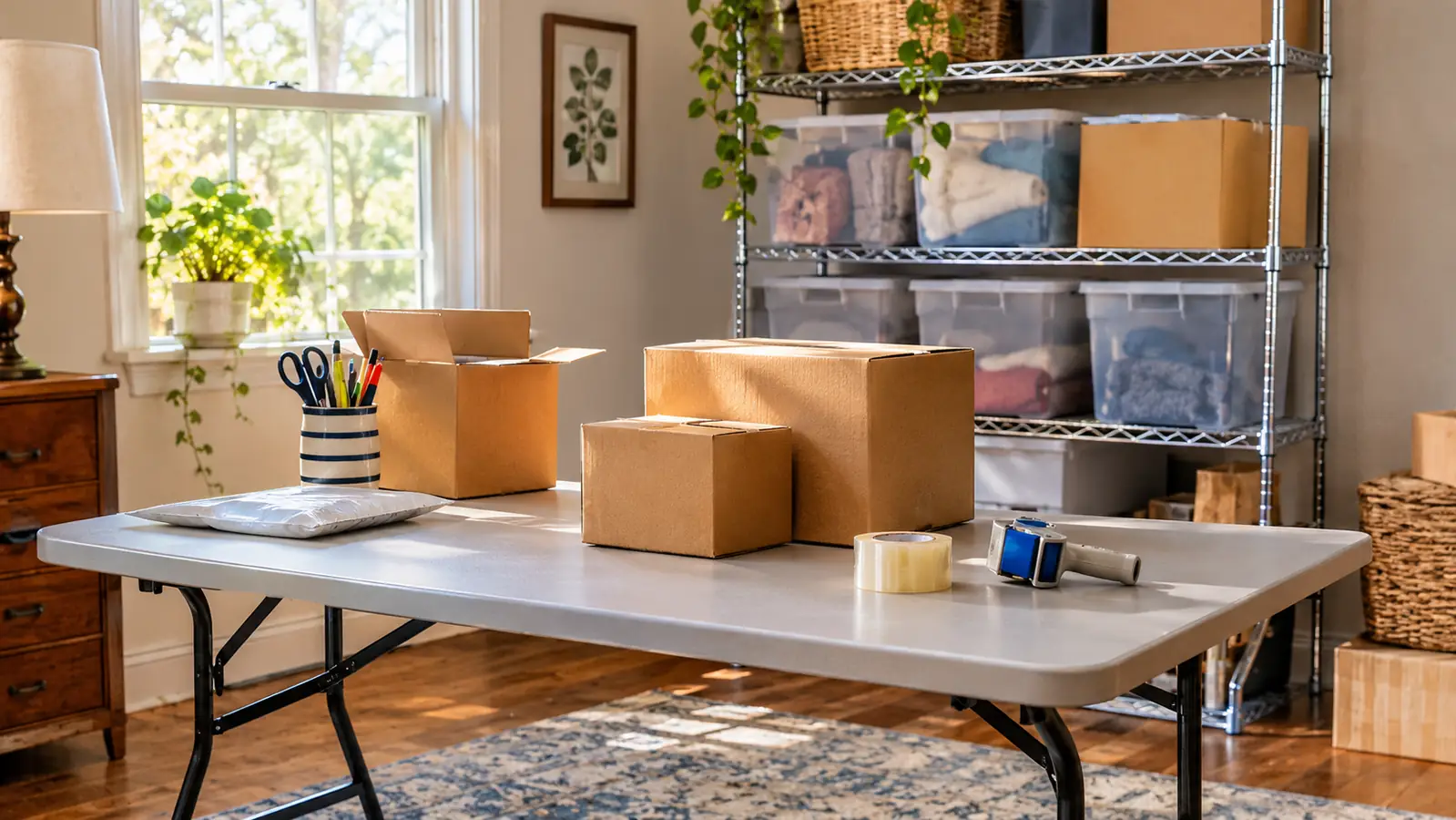
I have a kitchen scale in the drawer by the stove and an ACCUTECK 8250 on the folding table in my shipping room. After nearly five years with the ACCUTECK and a week of weighing the same packages on both, the short answer is this: a kitchen scale can weigh a blouse. It is not the tool for a boxed pitcher and four plates. I spent 27 years behind a post office counter outside Dayton, Ohio, and I have been reselling thrifted women's clothing, shoes, and vintage kitchenware and housewares since spring 2021, about five and a half years. I know what a shipping scale needs to do, and I know what a kitchen scale is good for. They are not the same job.
The difference is not accuracy, at least not in the way people usually mean it. A decent kitchen scale can be very accurate. The difference is capacity, weighing surface, and the small routines that keep a shipping room moving. A kitchen scale is built to sit on a counter and weigh a bowl of flour. A postal scale is built to sit next to a printer and weigh a package that is already taped shut. Once you have a box in front of you, the kitchen scale starts asking you to make compromises.
| ACCUTECK 8250 | Kitchen scale | |
|---|---|---|
| Maximum weight | 50 pounds, enough for a boxed set of dishes or a pair of boots | Usually around 10 to 11 pounds on a standard kitchen scale |
| Readout for postage | 0.1 ounce increments, with kg, lb/oz, and oz modes | Usually grams, so you convert to ounces before you print a label |
| Small-item resolution | 0.1 ounce, about 2.86 grams | Often 1 gram, which is finer for very small items |
| Tare and hold | Tare and hold functions | Tare on most models, hold is uncommon |
| Weighing surface | Holds a shoebox or a small boxed bowl | Made for a cereal bowl or a food container |
| Power | AC adapter or AAA batteries | Usually AAA batteries only |
| Storage | Folds and weighs 2 pounds | Slim enough for a kitchen drawer |
| Best job | Packing and labeling packages | Cooking and portioning food |
Where the ACCUTECK 8250 Wins
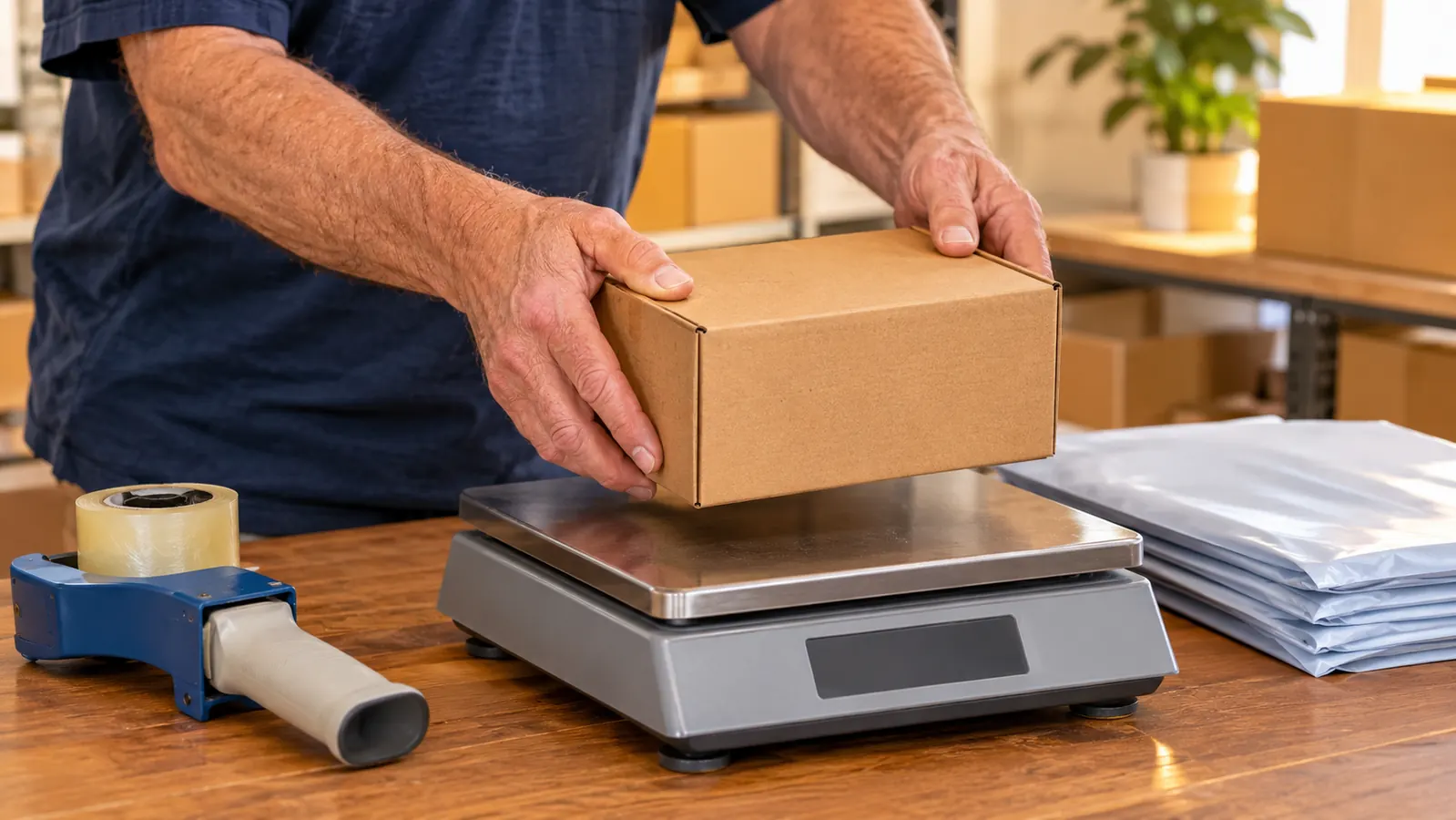
The first win is capacity, and it is not a small one. The ACCUTECK 8250 is rated to 50 pounds. I ship 8 to 15 packages a week, more in November and December, and most are clothing in poly mailers, so many of them are light. But the vintage kitchenware is not light. A boxed stoneware bowl, a set of plates, a cast iron skillet, those can push past 10 pounds fast. A standard kitchen scale tops out around 11 pounds. When a box goes over that, the kitchen scale does not give you a rough number or a warning. It gives you an error, and you are back to guessing. I had two packages come back for postage due in late 2021 because I guessed at the counter. That is why the ACCUTECK was the first real piece of equipment I bought for this business, in January 2022.
The second win is the hold function. Tare is useful: I put an empty poly mailer on the scale, press tare, and the scale ignores the mailer while I add the garment. Hold is the one that matters when a box is wider than the weighing surface and covers the display. I press hold, the number locks, and I can read it without leaning over the box. Most kitchen scales have tare. Very few have hold. If you have ever tried to read a kitchen scale through the side of a cereal box, you know why that matters.
The third win is the small stuff that keeps a shipping room moving. The LCD is backlit, which sounds like a brochure line until you are weighing packages at 6:30 in the morning in a spare bedroom with one lamp on. It reads in kg, lb/oz, and oz, and I keep it on lb/oz because eBay and Poshmark want ounces. It runs on the included AC adapter or AAA batteries, and I keep it plugged in. The auto shut off saves batteries when I forget. It folds, and it weighs 2 pounds, so it does not take over the table. None of those things are exciting. All of them are the reason I do not think about the scale during a packing session.
The weighing surface is the quiet win. I do not need a giant platform, but I do need one that can hold a shoebox without the box hanging off both sides. A kitchen scale is built around a smaller footprint, because it is meant to hold a bowl or a plate. When I set a taped box on a kitchen scale, I spend more time centering it than weighing it. The ACCUTECK lets me set the box down, wait for the number, and move on. That is the whole job. It also helps that the scale is a counter scale, not a folding travel gadget. It stays put next to the printer, which is where I need it.
Where a Kitchen Scale Wins
A kitchen scale wins on size and storage. It is small, it is light, and it lives in a drawer. If your shipping room is a corner of the kitchen table and you put everything away after each session, that matters. The ACCUTECK is a counter scale with a cord and a footprint. It lives on my folding table next to the printer, and it stays there. If you do not have a permanent spot, a kitchen scale is easier to live with.
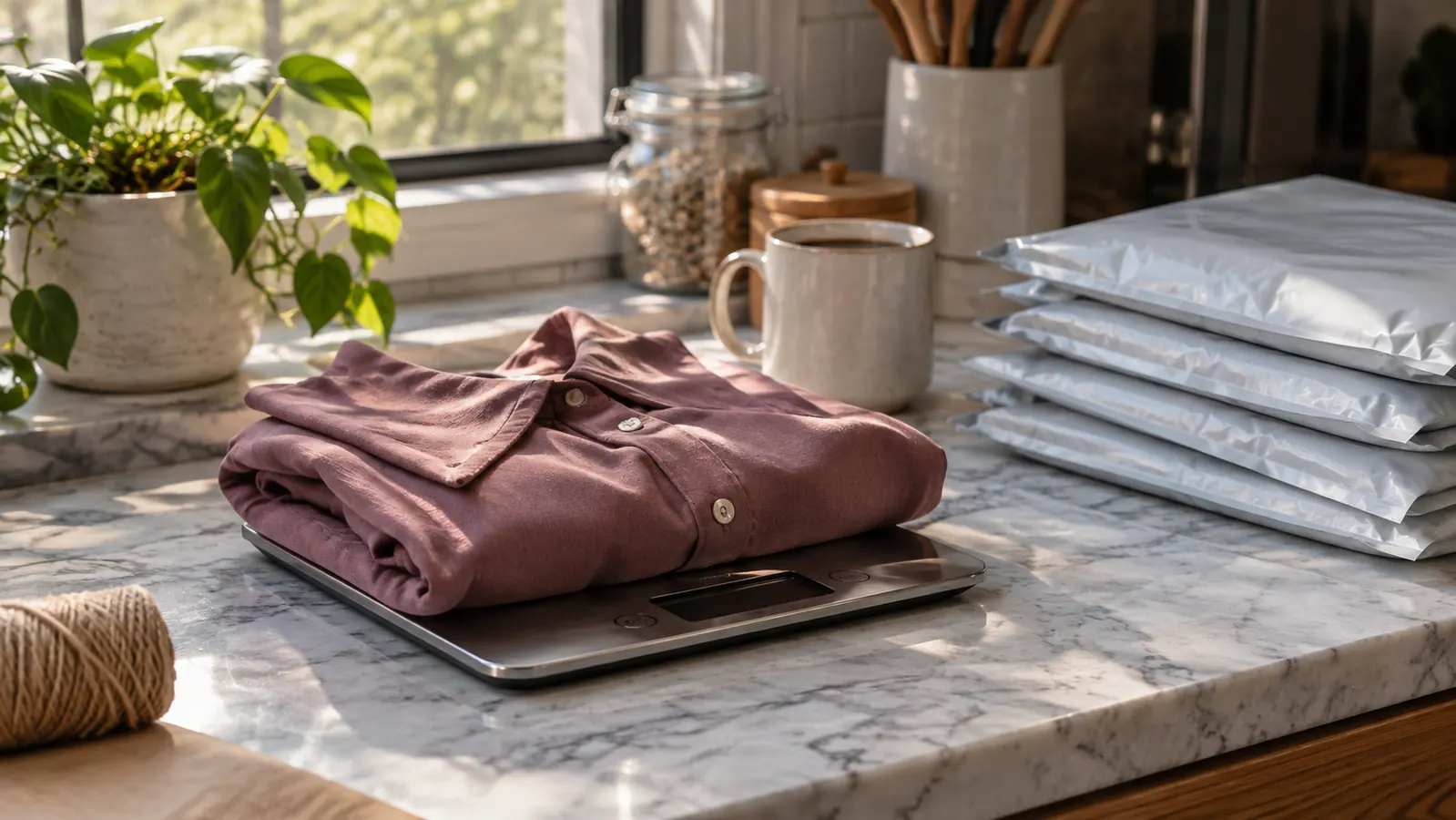
It also wins on fine resolution for very small items. Many kitchen scales read in 1 gram increments, which is finer than 0.1 ounce. For a single pair of earrings or a tiny piece of jewelry, 1 gram is a tighter number. The catch is that the number is in grams, and the label wants ounces. I can do that math, but I do not want to do it 12 times on a Tuesday. If you sell only small, light items and you already own a good kitchen scale, you can ship for a while without buying anything else. I would not call it the right tool, but I would call it a workable first tool for a very small operation.
The last kitchen scale advantage is that it is already there. Most people do not have to go buy one to get started. They can pull it out of the drawer, weigh a poly mailer, and print a label. That is a real advantage when you are testing whether reselling is for you. I would rather see someone use the scale they own for ten light packages than guess at the counter and eat a postage due charge. The kitchen scale is not the enemy. It is just a temporary answer to a different question.
Stop guessing ounces at the counter
The ACCUTECK 8250 gives you a 50 pound capacity, a 0.1 ounce readout, tare and hold, and a backlit display that is readable in a dim shipping room. It is the scale I have used on this table since January 2022.
Amazon See the ACCUTECK 8250 on Amazon →How I Compared Them
I did not run a laboratory test. I cleared the folding table, put the kitchen scale on one side and the ACCUTECK on the other, and weighed the same three packages on both. The first was a poly mailer with a pair of jeans, about 2 pounds. The second was a box with four stoneware mugs, about 7 pounds. The third was a box with a pitcher and plates, about 14 pounds. I weighed each one three times, writing down what each scale said.
The first two packages matched closely. The kitchen scale was within an ounce on the jeans and within an ounce on the mugs, which is fine for a clothing order. The third package was the end of the test. The kitchen scale had an 11 pound limit, so the 14 pound box was not going to work. It flashed an error and stopped. The ACCUTECK read 14 pounds 2.4 ounces and held the number while I moved the box. That is not a fair fight on accuracy. It is the actual fight you have when a box of dishes is sitting in front of you.
The other difference was the label. The ACCUTECK reads in pounds and ounces, so I typed 14 lb 2.4 oz into the listing and printed the label. The kitchen scale reads in grams on most models, so I would have had to convert the gram reading into ounces. I can do that once. I do not want to do it at 9 p.m. with a tape gun in my hand and Gene waiting to carry boxes to the porch. The tool that removes a step is the tool I reach for.
I also weighed a 1 pound poly mailer on both. The kitchen scale read 454 grams. The ACCUTECK read 1 pound 0.0 ounces. Both numbers were correct. The difference was that I could type the ACCUTECK number straight into the shipping form. The kitchen scale number needed a conversion first. For one package, that is nothing. For a stack of 12 packages on a Sunday night, it is the difference between finishing before the carrier pickup and missing it.
The kitchen scale was not wrong. It was just too small for the packages that actually needed weighing.
What the Specs Mean in a Shipping Room
Here is the plain breakdown. The 50 pound capacity covers everything I ship, including a boxed set of dishes. The 0.1 ounce readout is the unit the carriers use, so there is no conversion. The tare function lets me zero out a mailer or a box. The hold function locks a reading when the package covers the display. The backlit LCD is readable in a dim room. The scale reads in kg, lb/oz, and oz. It runs on the included AC adapter or AAA batteries, and it has auto shut off. It folds, and it weighs 2 pounds.
The 2.86 gram accuracy number is the same 0.1 ounce in metric clothing. I do not need to think about it. What I need is a number that matches the label. The ACCUTECK gives me that. The kitchen scale might give me a more precise number in grams, but precision without the right unit is just extra work. That is the whole comparison in one sentence.
I also like that it is a counter scale. That sounds like a small thing, but a counter scale is meant to sit in one place and be part of a workflow. I put the mailer on, press tare, add the garment, read the ounces, and type them into the listing. The scale is next to the printer. The tape gun hangs on the shelving unit. The poly mailers are in a bin below. The less I have to move, the faster the session goes, and the less my right thumb complains. I have mild arthritis in that thumb, so I notice every extra squeeze and every extra reach.
The 50 pound limit is not a suggestion, and that matters more than people think. A kitchen scale is often sold with a limit near 11 pounds because that is plenty for food. Shipping is not food. A boxed set of vintage plates can be 12 pounds before the bubble wrap. A pair of boots can be 4 pounds. A winter coat can be 5. The ACCUTECK covers all of those with room to spare. When I package a heavy item, I do not have to weigh it in two trips or guess whether the scale will complain. I set it down and read the number. That is the point of having a scale at all.
Who Should Buy Which
Buy the ACCUTECK 8250 if you ship boxes, dishes, shoes, coat lots, or anything that can pass 11 pounds. Buy it if you want the readout in ounces, if you want hold, if you want to keep the scale plugged in, and if you have a spot on a table where it can live. That is my situation, and I have not regretted it once in nearly five years. I drop packages at the post office counter or schedule a carrier pickup from the porch, and the scale has made both routines simpler because the weight on the label is the weight on the box.
Keep the kitchen scale if you ship a handful of lightweight poly mailers a week, if you already own a good one, and if you do not mind converting grams. It is a real scale and it can get you through your first small batch of clothing orders. I would not use it for a boxed bowl or a set of plates. I would not use it for anything that covers the display. And I would not use it if I had to do the ounce conversion more than once a day.
If you are in between, use the kitchen scale for your first ten light packages and write down the weights. When you hit a box that will not fit or a package that goes over the limit, that is your signal. The ACCUTECK is the next step, and it is the step I wish I had taken before two packages came back postage due. I did not need a fancier kitchen scale. I needed a postal scale.
Put the right scale next to the printer
If you are packing from a spare room and guessing at the counter, stop. The ACCUTECK 8250 has the capacity, the hold function, and the ounce readout that a shipping table actually uses. It has been on my folding table since January 2022.
Amazon Check the ACCUTECK 8250 on Amazon →