
Two packages came back to me in the same week in the fall of 2021, both stamped postage due. One was a CorningWare casserole dish on its way to Oregon. The other was a pair of wool trousers. I had guessed both weights at the counter instead of knowing them, and I guessed wrong on both. The woman in Oregon paid the difference out of her own pocket. I still think about that.
I spent twenty-seven years behind a small-town post office counter before I retired, which means I knew exactly what I was doing wrong. I just had not bought the tool that would stop me doing it. In January 2022 I bought the ACCUTECK 8250 digital postal scale. It was the first real piece of equipment I ever bought for this reselling habit of mine, and it has sat within arm's reach of my label printer ever since. Nearly five years. This is not the review that tells you a scale changed my life. It is the review I wish someone had handed me, including the parts that irritate me.
The Quick Verdict
A plain, accurate counter scale that has survived nearly five years of near-daily use. Buy it for the tare button. Do not buy it expecting it to solve dimensional weight.
Amazon Check Today's Price →The scale that ended the postage due envelopes
Fifty pound capacity, 0.1 oz precision, a tare button I press on every single box, and an AC adapter so it never runs dry mid-batch. Nearly five years in my shipping room and still the first thing I turn to.
Amazon Check Today's Price on Amazon →How I've Used It, Honestly
Before January 2022 I weighed things two ways, and both were bad. The first was a kitchen scale that read in whole ounces and shut itself off if I looked at it wrong. The second was the flat guess, where you decide a package feels like a medium and hope the clerk agrees with you. The kitchen scale was worse than the guessing, honestly, because it handed me a number I trusted and the number was rounded. A wool blazer at fifteen and a half ounces read as fifteen, and fifteen sat on the wrong side of a line. The readout on the ACCUTECK goes to 0.1 oz. That half ounce is the entire reason I bought it.
The scale lives at the left end of my six-foot folding table in the spare bedroom I call the shipping room, next to the printer and below the wire shelving where the inventory bins go. It arrived with both an AC adapter and a set of AAA batteries. I plugged it in on day one and have never taken it off the adapter, though the batteries are the reason it can travel to the kitchen when I need a weight for a listing photo. The unit itself weighs about two pounds, so moving it is not a chore.
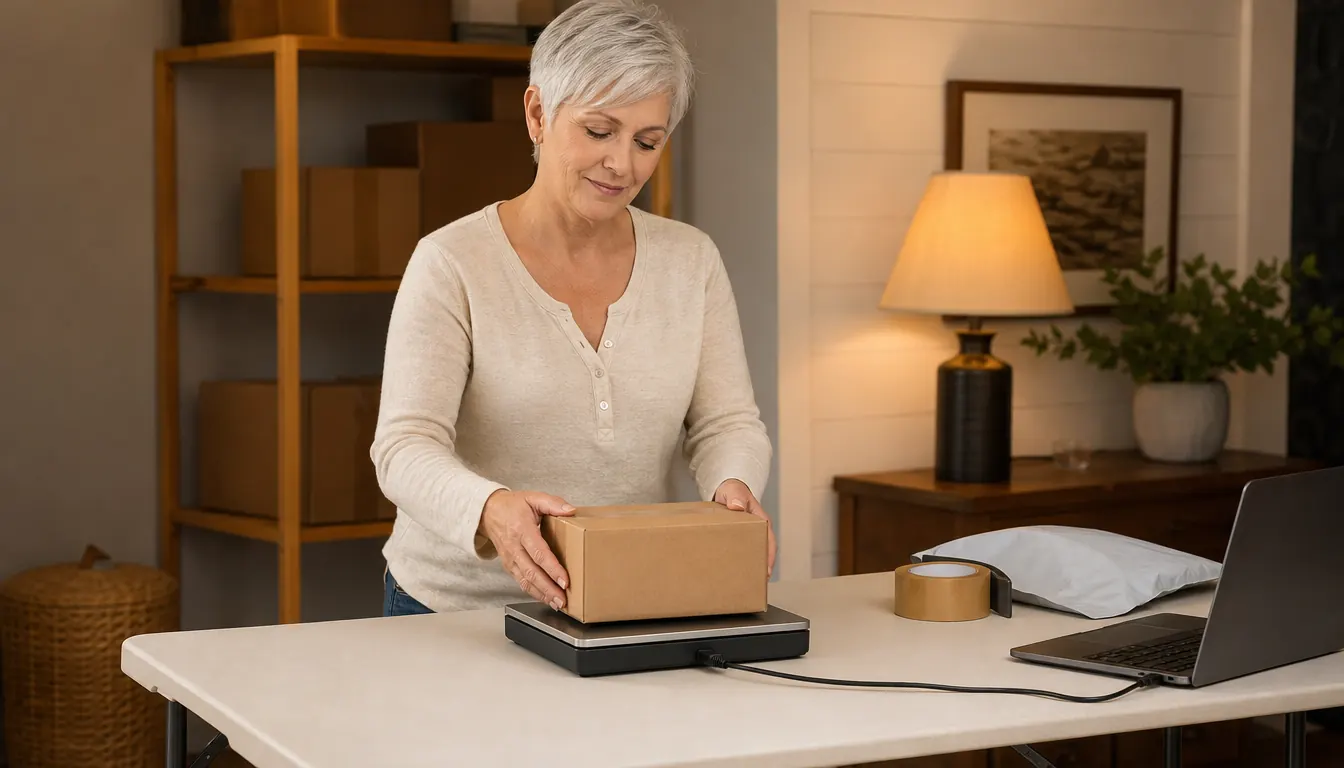
My routine has not changed in five years. I set an empty box on the platform, press tare, and the display drops back to zero. I load the item, add the cushioning, and read the weight. Then I key it into the label and the box goes onto the rolling cart. The tare button is the whole reason I chose this model over a plainer one. Subtracting the weight of a box in my head, at sixty-one, across a hundred boxes, is how mistakes happen.
Volume here runs eight to fifteen packages a week, and considerably more from late November through the middle of December. I am writing this in November, so the scale is getting a workout right now. Clothing goes into poly mailers. Glassware and dishes go into boxes with bubble wrap. Shoes go into boxes. Three different jobs, same two buttons.
What Nobody Tells You: An Accurate Weight Is Only Half the Job
Here is the thing the listing photos will not tell you, and the thing I most wish I had understood in 2021. A postal scale solves exactly one of the three ways you can lose money on shipping. It tells you the weight. It does not tell you the zone, and it does not tell you the size. Carriers charge by dimensional weight when a box is big and light, which means a large carton full of pillow inserts can cost more to send than a small dense box of books that weighs three times as much.
I sell vintage housewares, so I hit this constantly. A wide bowl wrapped in bubble wrap is light and bulky. The scale reads three pounds and the label comes out higher than three pounds would suggest, because the box is what is being priced, not only the contents. No scale on the market fixes that. You fix it by choosing a smaller box, and by understanding that the number on the display is a starting point rather than a final answer.
Here is a real one from this past spring. A set of four stoneware mugs, wrapped and boxed, came to just over two pounds on the display. That number was correct and it was useless, because the carton measured eleven inches by eleven by six and the carrier was pricing the size rather than the two pounds. I could not make the mugs lighter. What I could do was find a smaller box, stack the mugs two by two instead of in a row, and take the outer dimensions down far enough that size stopped being the deciding factor. The scale told me the truth about weight. The rest of that afternoon was me learning, again, that weight is one of three numbers and not the loudest one.
The same goes for the address. The scale cannot know that a package going three states over costs less than the same weight going to the coast. What the ACCUTECK does is remove the guessing from the one variable you actually control at your own table. That is a smaller promise than the product page makes, and it is the honest one.
Where the 0.1 oz Reading Actually Earns Its Keep
Most of the time, precision to a tenth of an ounce changes nothing. A three pound sweater is a three pound sweater. If you sell clothing by the poly mailer, you could weigh on a kitchen scale and never notice a difference. I say that as someone who owns both. But there are specific moments where the fine reading pays for itself, and they all happen at a boundary.
The big one is the line between first-class mail and priority. Under that ceiling, my packages go for less. Over it, the rate steps up. The difference between fifteen ounces and seventeen ounces is not incremental, it is a different service. On a pair of wool trousers, that boundary is easy to cross and easy to misjudge by eye. The scale reads to 0.1 oz, roughly 2.86 grams, which is finer than the decision requires. Fine by me. I would rather have margin than a coin flip.
Take a wool blazer from this past October. On the hanger it feels like nothing at all. Folded into a 10x13 poly mailer with a sheet of tissue, it read fifteen point four ounces, which put it under that first-class ceiling with a little room to spare. A year earlier I would have called it a pound, paid the step-up, and never known the difference. Half an ounce under a line is a good day. Half an ounce over is the envelope in the mailbox. The display tells you which one of those you are standing in, and that is the whole benefit, plainly stated.
The second place precision matters is the pound lines on heavier items. A pair of boots that lands right at sixteen ounces versus seventeen is a rate change. A set of four dessert plates that lands at two pounds and a hair versus one pound fifteen is a rate change. Guessing at those is how the postage due envelope ends up in your mailbox a week later.
One more, and this one is not about postage at all. When a buyer messages to ask what shipping would run, I can put the item in its mailer, weigh it, and answer in the time it takes to type. That is a small thing that makes a small shop feel like a shop.
The scale cannot know the zone and it cannot know the size. What it does is remove the guessing from the one variable I actually control at my own table.
The Annoyances, Because There Are Some
Auto shut off. The scale powers itself down when it sits idle, which is sensible and which means it is dark every time I walk into the room. I tap the platform, it wakes up, and I get on with the morning. After nearly five years I do it without thinking about it. But if you are the sort of person who finds that irritating in small appliances, know it going in.
The display sits on the body of the scale, so a large box can cover it. This is where the hold button earns its place. I set the box down, press hold to lock the reading, lift the box off, and read the number at my leisure. That is what the button is for and I use it far more than I expected to. When the box is small, the screen is large and backlit and I can read it from a standing position without leaning in, which matters more to me now than it did five years ago.
Fifty pounds is the ceiling. For clothing, shoes, and kitchenware, that ceiling is theoretical. I have never come close to it. If you are shipping furniture, a set of free weights, or anything that needs a freight label, this is the wrong tool and no amount of goodwill about it will change that. It has a foldable form factor per the manufacturer's description, so it stores flat when I need the whole table clear for a wrapping job.
I keep a set of AAA batteries in a drawer for the day the adapter gives out. In nearly five years I have not needed them, which is either a compliment to the adapter or a sign that I should stop saving things for a rainy day. The unit switches between kilograms, pounds and ounces, and I have pressed the wrong one more than once. It takes a second to cycle back. Not a defect, just a thing my fingers do.
What Nearly Five Years of Daily Use Looks Like
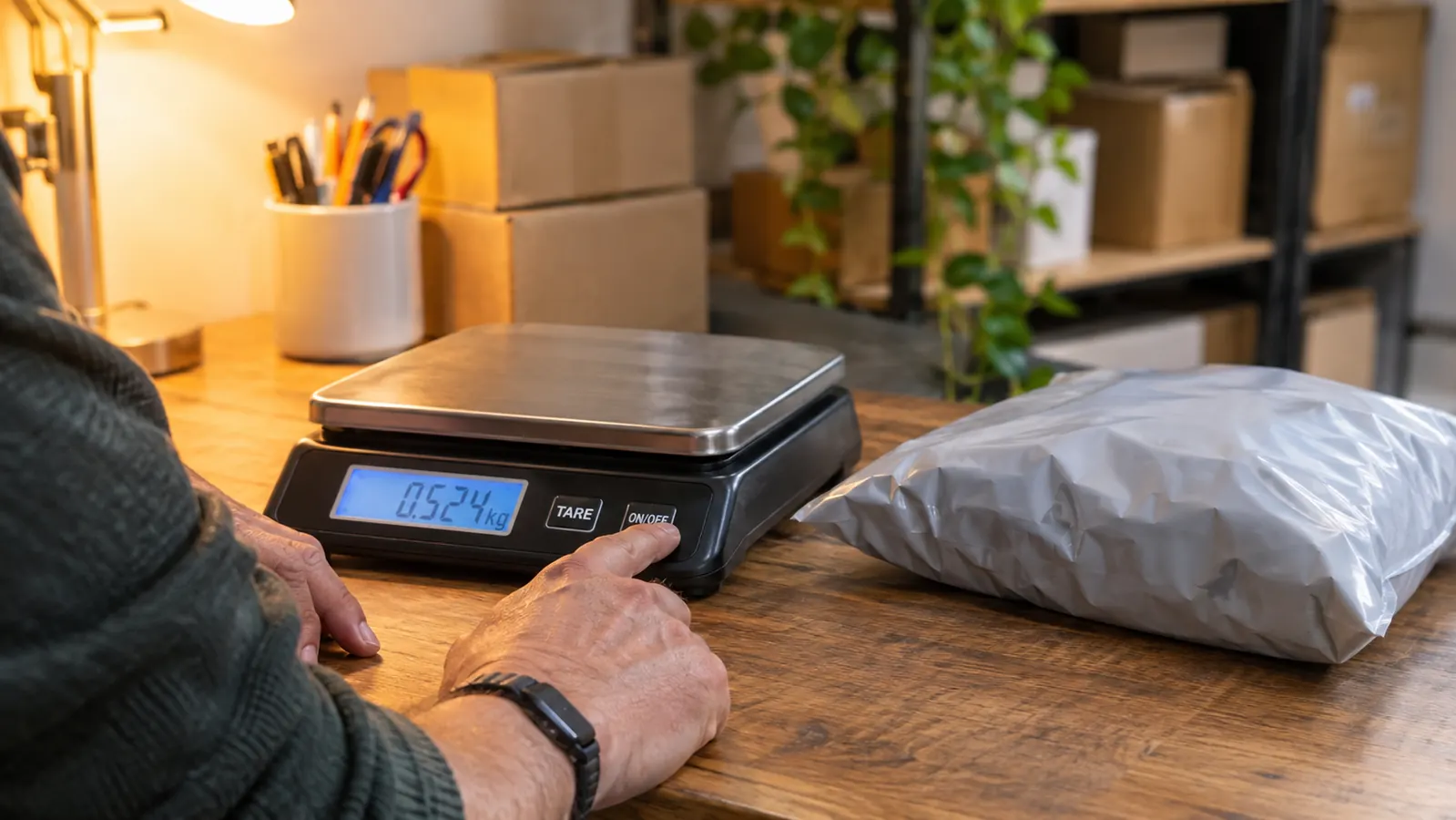
I have weighed a great many packages on this thing. Thousands of labels have come off the printer beside it, and every one of them started as a number on that display. The platform has not cracked. The buttons have not gone mushy. The reading has not drifted in any way I could detect, and I check it the way a former postal clerk checks things, which is to set a known item on it and compare that against the counter scale when I drop off a batch.
I do that check roughly once a month, usually on a Tuesday when I have a batch to carry up to the counter anyway. I weigh three boxes at home, write the numbers on a sticky note, and watch each one go onto the counter scale when I hand it over. In nearly five years the numbers have matched every time but twice. Both times the gap was under an ounce, and both times I had weighed the item before I added the box, which is a me problem rather than a scale problem. I have also carried it out to the porch for a carrier pickup in the rain, and it has ridden in the car to the post office more than once when I wanted a second opinion before a big batch.
That is not a laboratory test. It is the test that matters to me, because the only question I have is whether the number on my table matches the number at the counter. It has, consistently. When a discrepancy does show up, it is because I weighed the item before I added the box, not because the ACCUTECK was wrong. Two pounds of equipment, five years, no drama. I have owned a number of small appliances that could not say the same.
What I Liked
- Tare button does the container arithmetic so I do not
- Hold button locks a reading when a big box covers the display
- Reads to 0.1 oz, finer than any shipping decision requires
- Runs on the included AC adapter or AAA batteries
- Large backlit LCD readable from a standing position
- Nearly five years of near-daily use with no drift I could detect
Where It Falls Short
- Shuts itself off when idle, so it is dark when you walk in
- A large box can cover the display unless you use hold
- Fifty pound ceiling rules out furniture and freight
- One unit button cycles through kilograms, pounds and ounces, and I hit it by accident
Who This Is For
If you ship a handful of parcels a week out of a spare room, and you are currently guessing weights or weighing things on a kitchen scale that rounds to the nearest ounce, this is the tool that ends that particular problem. It suits clothing sellers, shoe sellers, people sending books and small housewares. It suits anyone who has stood at a counter and watched a clerk re-weigh a box with a particular expression on their face.
It also suits hands that do not enjoy fiddly work. Tare is one press. The platform is flat and open, so nothing needs clipping, hooking, or holding steady. My right thumb has opinions about repeated squeezing, which is a conversation I have had with tape guns before. This scale has never asked anything of it.
Who Should Skip It
Skip it if your packages routinely run past fifty pounds, because the scale stops there and you will be guessing again at exactly the wrong moment. Skip it if you ship oversized but light items where dimensional weight dominates, since the scale will hand you a confident number that the carrier will then price differently. Skip it if you already own a reliable postal scale that reads to a tenth of an ounce, because this is a replacement, not an upgrade.
And skip it if you want a device that talks to your computer. You will not be pairing this with anything. It is a scale with a display and two buttons that carry the load, plus a unit button my fingers keep finding. For me that simplicity is the appeal rather than the drawback. I spend enough of my day coaxing a laptop and a printer into cooperating. The scale just sits there and tells the truth.
Nearly five years, thousands of labels, one scale that never argued with me
Fifty pounds, 0.1 oz precision, tare and hold, AC adapter or batteries. It is the least interesting purchase I have made for this business and the one I would replace first if it ever quit.
Amazon Check Today's Price on Amazon →