
The first thing I tell anyone who asks about Duck small bubble cushioning wrap is that it is not a magic material. It is a roll of small bubbles, 12 inches wide and 175 feet long, perforated every 12 inches. I have bought it since January 2022, nearly five years now, for the vintage Pyrex, glassware and dishes I sell on eBay and Poshmark. I pack 8 to 15 orders a week from a spare bedroom outside Dayton, Ohio. The wrap does one job well: it cushions light and fragile things inside a box. It does not make a weak box strong, and it does not replace common sense.
That sounds like faint praise. It is not. Before I switched, in late 2021, a Pyrex bowl arrived in pieces. The box was fine. The packing was not. I had used newspaper and a little tape, and I had wrapped the bowl the wrong way. Since I started using Duck small bubble wrap in January 2022, I have not had a dish break in transit. Nearly five years, thousands of labels, no breakage on glass or dishes. That is the honest headline, and the rest of this review is the fine print.
The Quick Verdict
A light, reliable cushion for dishes and glass, provided you wrap bubbles in and use a proper box. Not the right choice for heavy or sharp items on its own.
Amazon Check Today's Price →The roll I reach for when a box has dishes in it
Duck small bubble cushioning wrap is 12 inches wide, 175 feet long, and perforated every 12 inches, so you can tear a sheet without a knife. It is the cushioning layer I have used since January 2022.
Amazon See the roll on Amazon →How I Use It in the Shipping Room
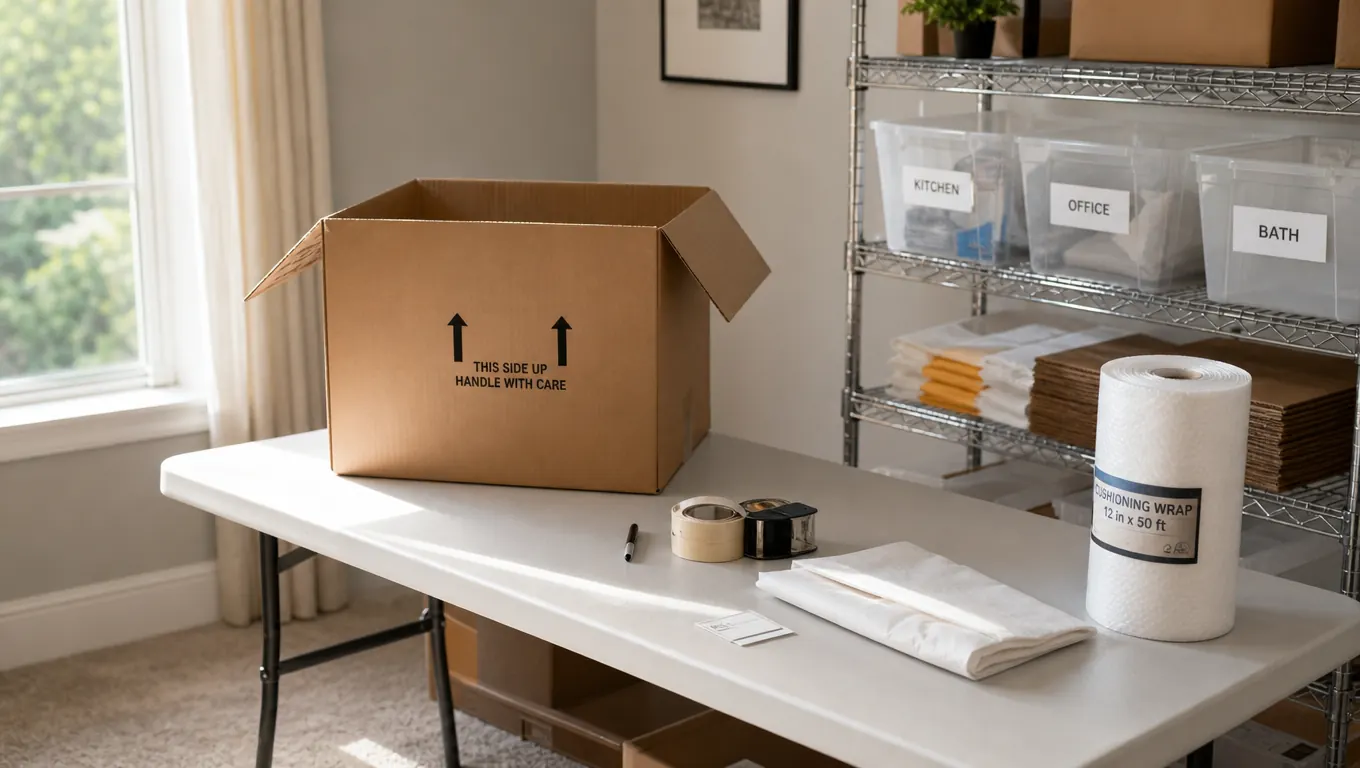
I pack in a spare bedroom I call the shipping room. There is a 6-foot folding table, a wire shelving unit with labeled bins, and a rolling cart for supplies. The Duck roll stands on the bottom shelf of the wire unit. My tape gun hangs on a hook. The scale and the label printer sit at the left end of the table. This is not a warehouse. It is a room where I try to keep one order moving without knocking over the last one.
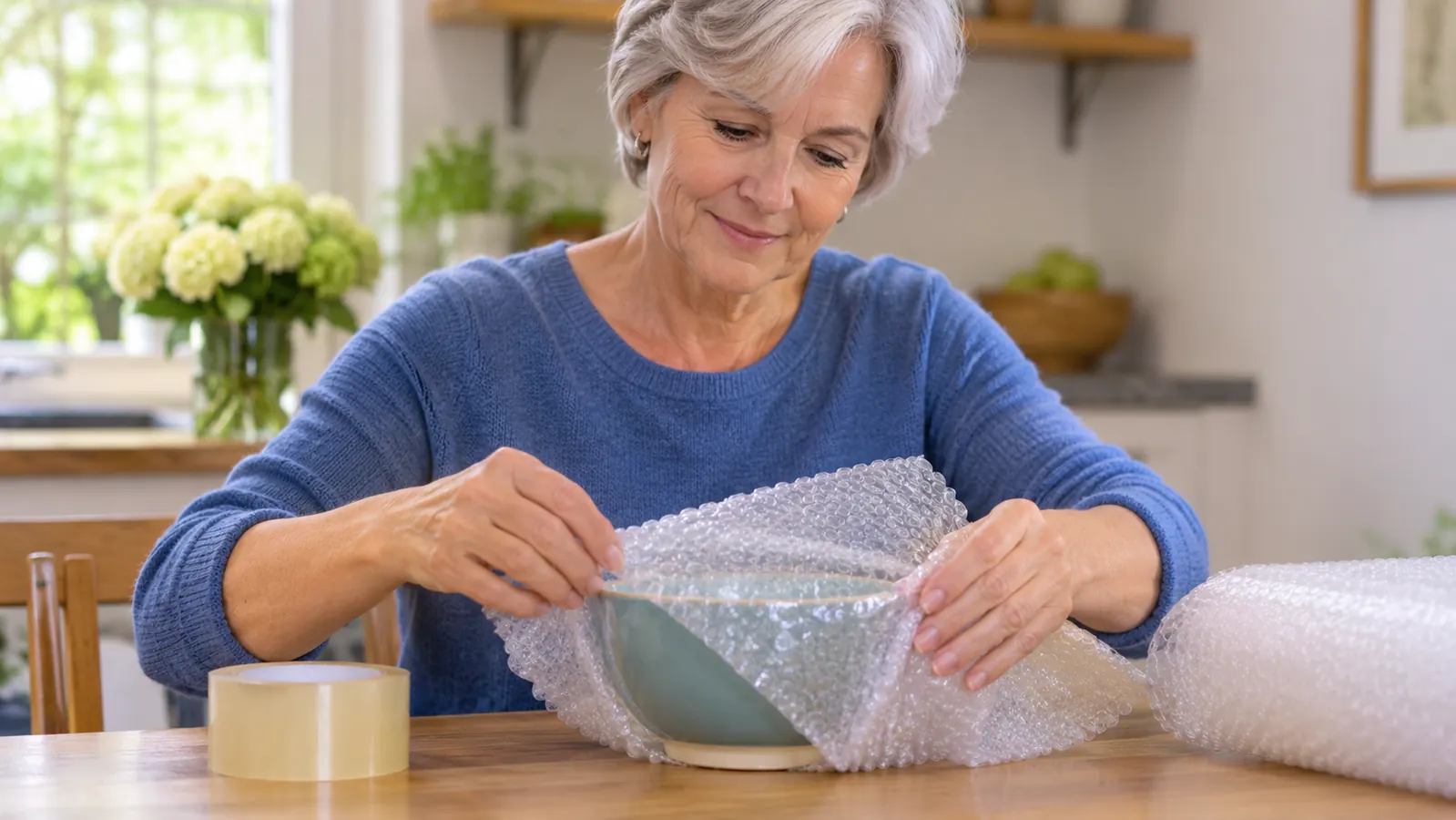
For a plate, I tear a sheet about 18 inches long at the perforation. I lay the plate face down in the middle, fold the corners over, and keep the bubbles against the plate. For a bowl, I do the same, then add a second sheet around the outside if the bowl is deep. For a mug, I put a small piece inside the cup, wrap the body, and add a second layer over the handle. The handle is the part that breaks. The wrap is not. I use it inside boxes only. I never put it inside a poly mailer. Bubble wrap in a mailer is the wrong shape and the wrong protection.
The perforation every 12 inches is the feature I use most. I do not keep scissors at the table. I tear with my hands. My right thumb has mild arthritis, so I appreciate anything that does not require a hard squeeze. The wrap is light, 1.1 pounds for the roll per the listing, so it does not push a package into the next weight tier the way a heavy cushioning material can. That matters when you are guessing weights at home and printing labels at the table.
The bubbles are small. That is the point. Small bubbles conform around curves and rims. Large bubbles leave gaps and create pressure points. But small bubbles also mean less loft. A single layer is not enough for a heavy bowl or a sharp edge. I use two layers on anything with a handle. I also use two layers on the bottom of the box. The bottom is where the weight lands. If I am shipping a stack of plates, I put a sheet between each plate and a double layer around the stack.
I bought my first roll in January 2022, a few months after the broken bowl. I have bought it since. The 175 foot roll lasts me about two months when I am shipping 8 to 15 packages a week. In November and December, it lasts less. I do not track the exact number of sheets. I track whether the roll is getting thin and whether I have a spare on the shelf. That is the inventory system. It is not a spreadsheet. It is a roll on a shelf.
What Nobody Tells You About Small Bubble Wrap
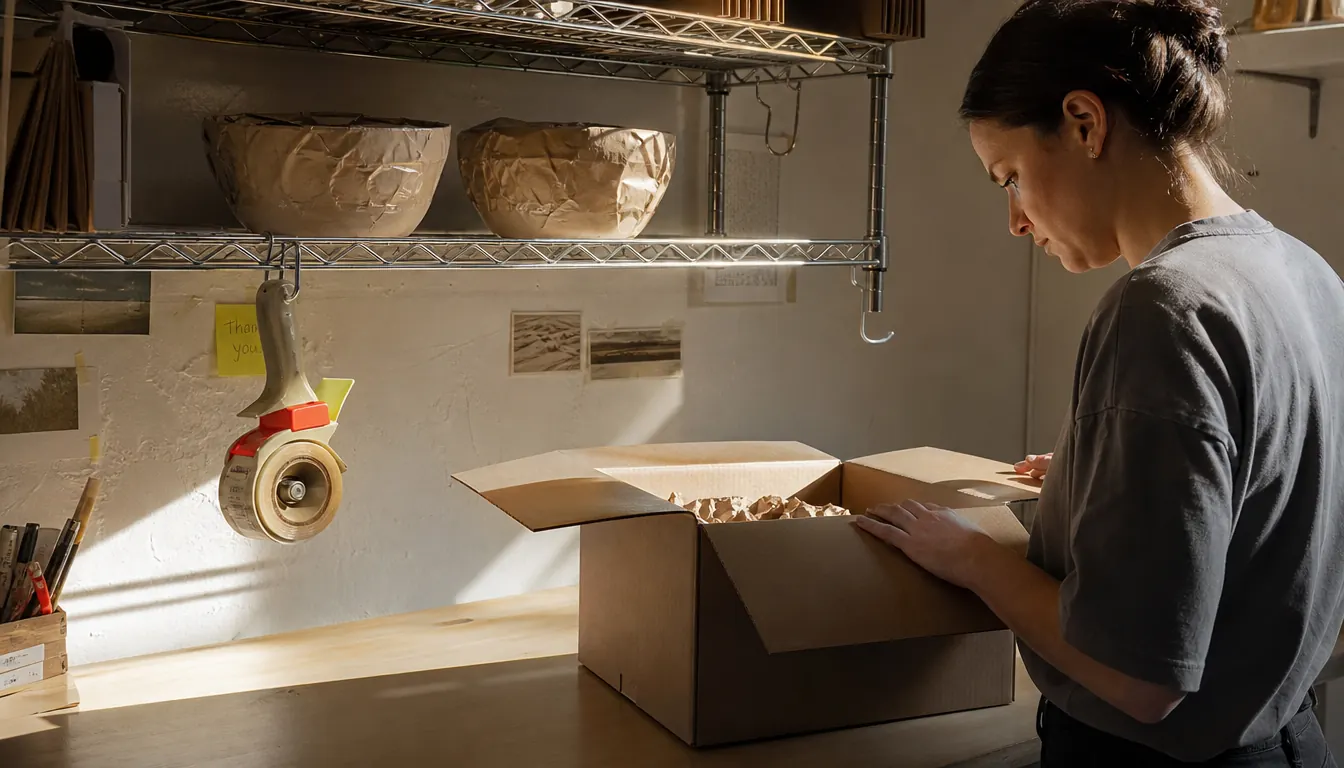
The first thing nobody tells you is that bubble wrap is a cushion, not a structural material. It will not turn a flimsy box into a safe box. If the box is too big, the item will slide around inside it, and no amount of wrap will stop that. I size the box so the wrapped item has about 2 inches of cushion on every side. Then I fill the empty space with crumpled paper or air pillows. The wrap protects the item from the box. The box protects the item from the world. You need both.
The second thing is that the direction of the bubbles matters. The listing says to wrap items bubble side in. I do that. The bubbles face the item, and the flat side faces the box. I have tried it the other way when I was in a hurry, and the wrap did not hug the dish the same way. It shifted. That is a small thing until a box gets dropped. I also tape the wrap closed. A loose sheet of bubble wrap is a loose sheet. It does not stay where you put it.
The third thing is the width. This roll is 12 inches wide. That is fine for a dinner plate, a mug, a small bowl or a glass. It is not enough for a large platter or a serving dish. I overlap two sheets and tape them together when I need more coverage. If you sell a lot of big platters, you will do a lot of overlapping. That is not a defect. It is the size. Buy the size that matches what you ship.
The fourth thing is the perforation. Every 12 inches is convenient for sheets, but it is not convenient for small pieces. If I need a short strip to go around a handle, I either tear a 12 inch sheet and fold it, or I tear past the perforation and get a ragged edge. I waste a little. I have accepted this. The tradeoff is that I never have to hunt for scissors, and I never cut a sheet too short because I was guessing.
Where It Has Held Up, and Where It Has Not
Where it has held up is glass and dishes. I have shipped vintage Pyrex, stoneware mugs, china plates, glass candle holders and small ceramic figurines. Since January 2022, I have not had a dish break in transit. I have had boxes arrive with crushed corners. I have had a buyer tell me the outer box looked rough. The dish inside was fine because the wrap and the box did their jobs. I am not going to promise that you will never have a break. I am telling you what has happened in my shipping room for nearly five years.
Where it has not held up is heavy or sharp items. I do not use this for cast iron. I do not use it for tools. I do not use it for anything with a pointed corner that can punch through a single layer. For a knife, I fold a piece of cardboard around the blade first, then use bubble wrap as a second layer. For a heavy bowl, I use a double layer and a smaller box. The wrap is not a suit of armor. It is a cushion. If you treat it like armor, you will be disappointed.
I also do not use it for clothing. Clothing goes in Metronic 10x13 poly mailers. That is a different job. Bubble wrap inside a poly mailer makes a lumpy package and does not protect anything that needs protecting. I keep the two workflows separate. Clothing in mailers. Dishes in boxes with Duck wrap. The separation keeps the shipping room from turning into a pile of materials that I use for the wrong thing because it is closer to my hand.
How I Decide When to Use It
My decision is simple. If the item is glass, ceramic or glazed, it gets Duck small bubble wrap. If the item is clothing, it gets a poly mailer. If the item is heavy and fragile, it gets two layers and a smaller box. If the item has a sharp corner, it gets cardboard first. If the item is a large platter, it gets two overlapping sheets. If the box is too big, I change the box. I do not try to fill a big box with wrap and hope. That is how you turn a safe item into a loose item.
A box of four mugs is a good example. I put a small piece inside each mug. I wrap each mug with a sheet, bubbles in, and tape it closed. I put a sheet in the bottom of the box. I stand the mugs upright, not on their sides, and put a sheet between them. I fill the top with crumpled paper. The box is small enough that nothing moves when I shake it. If it moves, I open it and add more. That is the whole method. It takes about four minutes for four mugs.
In November and December, I pre-wrap. I tear a stack of sheets and keep them on the table. I wrap the item, tape it, and set it in the box. I do not pre-wrap items that are still in inventory because the wrap takes up shelf space. I pre-tear sheets, not pre-wrap dishes. That keeps the shipping room from turning into a pile of half-finished packages. The roll is long enough that I do not worry about running out in the middle of a batch. I reorder when the roll gets thin.
The Honest Tradeoffs
The roll takes up space. It is 175 feet long, so it lasts, but it is still a roll. I keep it standing on the bottom shelf of the wire unit. When I am not using it, it stays there. When I am using it, I pull out a few feet and tear. I have never had the roll unwind on its own. I have had the end stick to itself. I find the end, pull, and move on. That is the whole storage story. It is not a system. It is a roll on a shelf.
It is plastic. I am not going to pretend otherwise. I reuse clean pieces when I can. If a piece comes back in a box from a supplier and it is clean, I keep it. But I do not ask buyers to reuse it, and I do not pretend that it is a compostable material. If that is a deal breaker for you, this is not the product for you. I am not going to talk you into it. I use it because it protects dishes, and dishes are what I sell.
The rating is 4.7 out of 5 from about 40,000 ratings. That tracks with my experience. The complaints I see are usually from people who expected it to do a job it is not designed to do. They expected it to fill a big box, or to protect a heavy item, or to replace a proper box. It is not void fill. It is not a moving blanket. It is small bubble cushioning wrap. When I use it for that, it works. When I ask it to be something else, it does not.
What I Would Change
I would change the perforation spacing. Every 12 inches is fine for plates and bowls. It is not fine for handles and small pieces. I would like a roll with a shorter tear line, or a second perforation option. I know that is a manufacturing decision, not something I can fix with tape. I still think it. I also would like the end of the roll to stay put. It does not unwind on its own, but the end can stick to the layer below it. I have to find it with my thumb. That is a small annoyance, not a reason to switch.
Would I buy it again? Yes. I have bought it again. I am on another roll now. I do not say that because I am loyal to a brand. I say it because the roll does the job I bought it for. I have tried a large bubble wrap from a moving box, and it was too much loft for a dinner plate. I have tried newspaper, and it left ink on a bowl. I have tried air pillows, and they shifted. The small bubble wrap is the one that stays where I put it and wraps the shape I need. That is enough.
What I Liked
- Light enough that it does not add much weight to a box
- Perforated every 12 inches, so I can tear sheets by hand
- Small bubbles conform to rims and curves
- I have not had a dish break in transit since I switched in January 2022
- Works with my tape gun and folding table setup
Where It Falls Short
- Not enough on its own for heavy or sharp items
- 12 inch width requires overlap on large platters
- 12 inch perforation can waste a little on short pieces
- It is plastic
- It is not void fill
Nearly five years, 8 to 15 packages a week, and I have not had a dish break in transit since I switched to Duck small bubble wrap in January 2022. That is the number I care about.
Who This Is For
This is for home resellers who pack dishes, glassware, mugs, small ceramics, vintage kitchenware and other fragile housewares. It is for people who want a light cushion that does not add much weight and who are willing to wrap bubbles in and use a proper box. It is for people who tear by hand and do not want to keep scissors at the table. It is for people who ship 8 to 15 packages a week from a spare room and need a roll that lasts.
Who Should Skip It
Skip it if you ship heavy cast iron, tools, sharp items or large furniture. Skip it if you need large bubble wrap for big items. Skip it if you want a compostable or paper based cushion. Skip it if you pack only clothing and already have poly mailers. Skip it if you are looking for void fill to take up space in a big box. This roll is for wrapping the item, not for filling the box around it. If that is not your job, you do not need it.
If your boxes have dishes in them, this is the roll to keep on the shelf
Duck small bubble cushioning wrap, 12 inches by 175 feet, perforated every 12 inches. I have used it since January 2022 for Pyrex, glassware and vintage dishes. Wrap bubbles in, use a proper box, and give the item room.
Amazon See the roll on Amazon →