

Two packages came back to me in the fall of 2021 stamped postage due, and both of them were my fault. I had spent 27 years behind a post office counter watching people set a box down and call it two pounds, and then I retired and did the exact same thing from my own shipping room. Guessing works right up until it does not. When it does not, either you eat the difference or the buyer does, and either way somebody ends up annoyed at you. I bought an ACCUTECK 8250 in January 2022, the first real piece of equipment I bought for this, before the label printer and before the good tape gun. Nearly five years later it sits in the same spot next to the printer and it gets used on every order I ship, which is usually eight to fifteen a week.
A postal scale is not a complicated machine. Mine weighs up to 50 pounds, reads in tenths of an ounce, runs off the included AC adapter or AAA batteries, and has exactly two buttons that matter to me: tare and hold. That is the whole tool. Accuracy is not the hard part. The hard part is building a habit where the box gets weighed the same way every time, at the same point in the packing, on a surface that is not fighting you. What follows is the habit, not the manual.
The one piece of equipment I use on every single order
50 pound capacity, reads to 0.1 oz, tare and hold buttons, AC adapter and AAA batteries both included. Nearly five years on my folding table and it has not missed a package yet.
Amazon Check Today's Price on Amazon →Step 1: Give the Scale a Hard, Level Home
Put it on something that does not give. Carpet is the enemy. So is a couch cushion, a bed, and the wobbly end of a folding table where the leg is missing its cap. A scale measures the force pushing down on its platform, and a soft surface lets that platform tilt, which means part of the package weight is going sideways instead of down. You will be off by ounces and you will never know it.
When the scale first arrived I set it up on the corner of the bed, because that was where I happened to be standing when I opened the box. Two packages later I noticed the same parcel read about three ounces lighter there than it did down on the kitchen counter. The bed was the problem, not the scale. It has lived on the folding table ever since, on the end nearest the window, and nothing on that table has moved since except the dust.
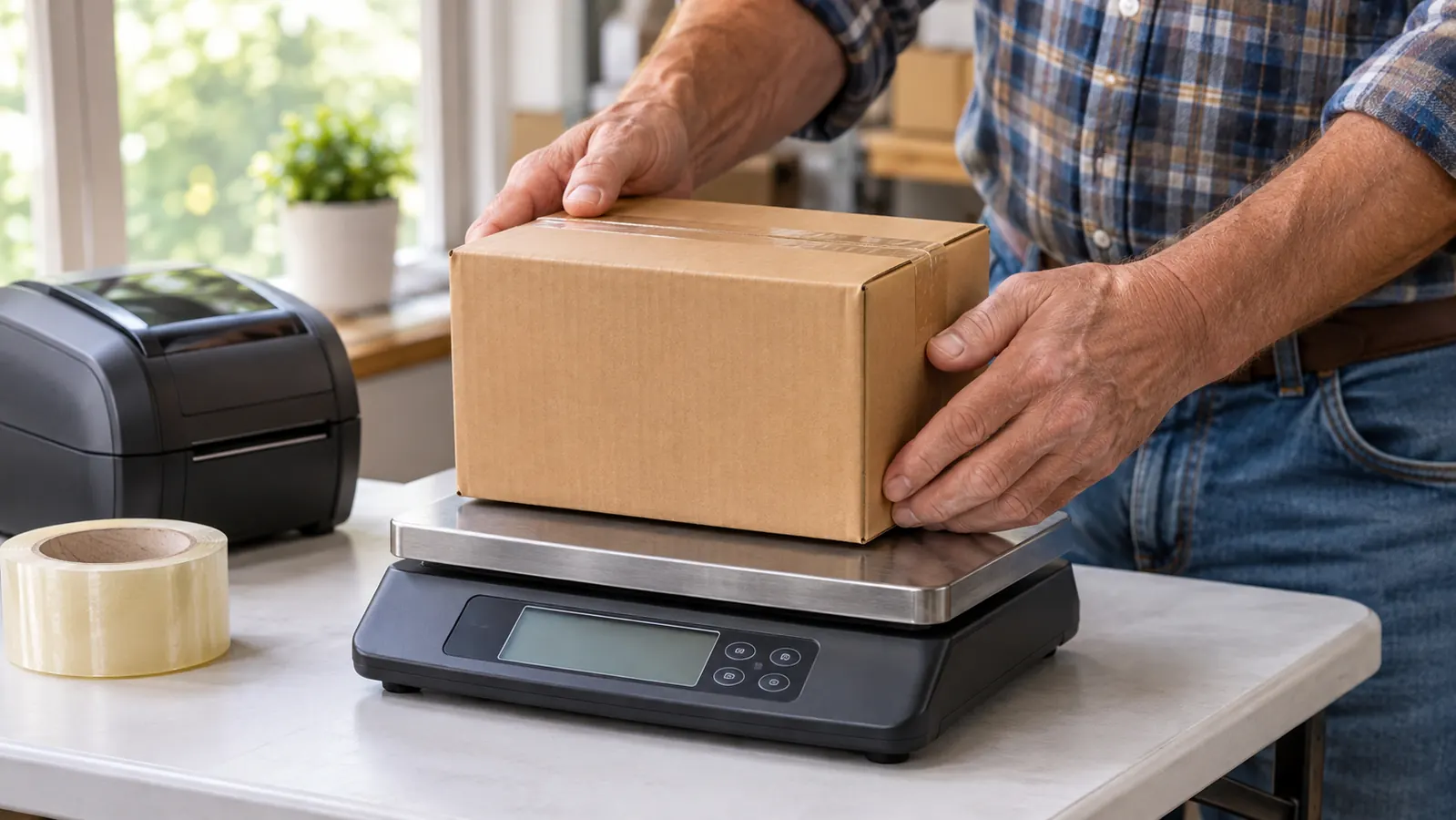
Mine sits at one end of a 6-foot folding table next to the label printer, with about a foot of clear space in front of it. That clear space matters more than it sounds. If the box overhangs onto a stack of poly mailers or leans against the printer, you get a number that is low and confident. Keep the platform clear. Keep the table itself from becoming the place where you set things down temporarily, because it will, and then you will weigh a box with a tape gun resting against the side of it.
And do not store anything on it. Not the tape gun, not a bin of sweaters, nothing. A scale that lives under a pile of inventory is a scale you stop trusting, and a scale you stop trusting is a scale you stop using, and then you are back to guessing at the counter.
Step 2: Zero It Out, Then Learn What the Tare Button Is For
Wake it up and let it settle on 0.0 before anything goes on the platform. Mine has an auto shut off, which is a good thing for the batteries and a small trap for me, because the display goes dark between orders and I have to press the button and wait a second for it to come back. Set a box down while it is still waking and you can catch a partial reading. Press, wait for the zero, then load it.
The tare button is the part most people never touch, and it solves a specific problem: a box too big to sit flat on the platform. I keep an empty plastic tote under the table. Set the tote on the scale, press tare, and the display goes back to 0.0 with the tote sitting right there. Now I can drop a box into the tote, let it sit flat and steady, and the number on the screen is the box alone with the tote already subtracted. For a wide, light carton of sweaters that overhangs in every direction, that is the difference between a reading and a guess.
Before I understood the tare button I tried the obvious workaround: weighing an overhanging box with a couple of paperbacks stacked under the far edge to keep it level. It worked about half the time, and it taught me nothing, because I had no idea whether the books were carrying weight or just pretending to. The tote and the tare button are better, and they are repeatable, which is the part that matters when you are packing four boxes in a row on a Tuesday morning.
The hold button does the same job in reverse. It locks the number on the screen so you can take the package off and still read it. That matters when the box is wide enough to hide the display, which is true of almost anything bigger than a shoebox. Weigh it, press hold, pull the box off, write the number down.
Step 3: Weigh the Package the Way It Will Travel
Weigh it closed. Tape, padding, label, everything. The number that counts is the one the carrier gets on their own scale at the counter or in the sorting machine, and they are not weighing your item. They are weighing your finished parcel, including the four inches of tape you used because the box was looking tired.
A blouse in a 10x13 poly mailer and the same blouse in a small box are two different shipments. Bubble wrap is not weightless. A sheet of it around a piece of vintage Pyrex adds real ounces, and if the item is already close to a pound boundary, that sheet is the difference between the rate you had in your head and the rate you pay. I weigh the finished, sealed package, after the label is on, because a thermal label is a fraction of an ounce and it costs me nothing to weigh the thing I am actually handing over.
And keep your hand off it. Do not steady the box with two fingers while you squint at the display. The scale is doing its job. Your hand is adding weight, and you will not guess how much.
Step 4: Round Up, and Watch the Big Light Boxes
A reading of 1 lb 2 oz and a reading of 1 lb 14 oz are usually the same price, because most package services round up to the next whole pound. That does not make the tenths of an ounce pointless. It means the tenths matter at the boundaries, and the boundaries come up more often than you would think. The line between a first-class package and the next service up sits right around a pound, and 15.9 oz versus 16.1 oz is a real difference in what you can send and what it costs.
The ACCUTECK reads to a tenth of an ounce, which sounds like more precision than a shipping label needs until you are sitting on a boundary. I had a pair of ankle boots come in at 15.9 oz on the scale, and they went out first class with room to spare. The next week a cardigan landed at 1 lb 1 oz and had to go a different way. Same table, same week, and the only thing that saved me an argument was the decimal point.
So round up. If the scale says 2 lb 3 oz, print 3 lb or let the software round it for you, but never print the lower number and hope. Under-declaring by an ounce is how the postage due stamp happens, and the postage due stamp always costs more than the postage would have.
Big light boxes are their own problem. A carton the size of a laundry basket full of sweaters can weigh under ten pounds and still be billed on the room it takes up, because carriers price large light parcels by size as well as by weight. The scale gives you an honest number and that number is not the one you should be planning around. If the box is big and light, check the size before you assume weight is what you are paying for.
Step 5: Write the Weight Down and Check It Against the Receipt
I write the weight on the box in marker before the label goes on. Two reasons. I pack in batches, three or four at a time, and by the time I get to printing I genuinely do not remember which carton was which. And when a label prints wrong, and one will, I can see at a glance what the number was supposed to be instead of opening the box to find out.
If I add anything after weighing, I weigh again. No exceptions. A sheet of tissue, a thank-you note, a second layer of bubble wrap: the box goes back on the platform. It takes four seconds and it is the easiest place in the whole process to lose an ounce.
Then the receipts are the audit. Every so often I compare what I actually paid for a batch against what the scale said. If a package comes back with a postage adjustment, I want to know whether I typed the number wrong or whether the scale is drifting. A postal scale that has been knocked around for nearly five years can drift. The ACCUTECK has held steady. If it ever stops, the receipt will tell me before a buyer does.
What Else Helps
The scale fixes the weight and nothing else. The rest of the table has to hold up too. A thermal label printer means I am not handwriting addresses or taping sheet paper to a box, which was my life for one winter and I would not go back to it. Poly mailers for anything soft, because a sweater does not need a box. I keep the 10x13 size for most blouses and jeans, step up for anything bulky, and the self-seal strip means I am not fighting a roll of tape at the end of a long batch. A tape gun with a real handle, because squeezing a bare roll of tape was hurting my right thumb and I have enough opinions about that thumb already.
Bubble wrap for glass and dishes, and only for those. I use the small-bubble kind, tear it at the perforations instead of hunting for scissors, and wrap with the bubbles facing in against the piece. I broke a bowl in late 2021 with a lazy wrap, switched to doing it properly, and nothing glass has broken in transit since. That is four years of shipping Pyrex and stoneware without a single claim, and I credit the wrap far more than I credit luck.
One thing that is not equipment at all: weigh before you list, not after. If the listing uses calculated shipping and you only discover at the label that the box is three pounds, you have already quoted the wrong number to a buyer. Weigh the item in its packaging the day you photograph it and put the number where you can find it. It takes one minute and it removes the whole argument.
A box that overhangs onto a stack of poly mailers will give you a number that is low and confident. That is the worst kind of number.
Stop guessing at the counter
50 pound capacity, 0.1 oz precision, tare and hold, AC adapter and batteries both in the box. The first thing I bought for this hobby and the last thing I would give up.
Amazon Check Today's Price on Amazon →